Hokusai
A rostrum camera gives the artist’s constant viewpoint.
Minimum of biographical information, historical, evidentiary. The work
black-and-white in tonal values.
Ikebana
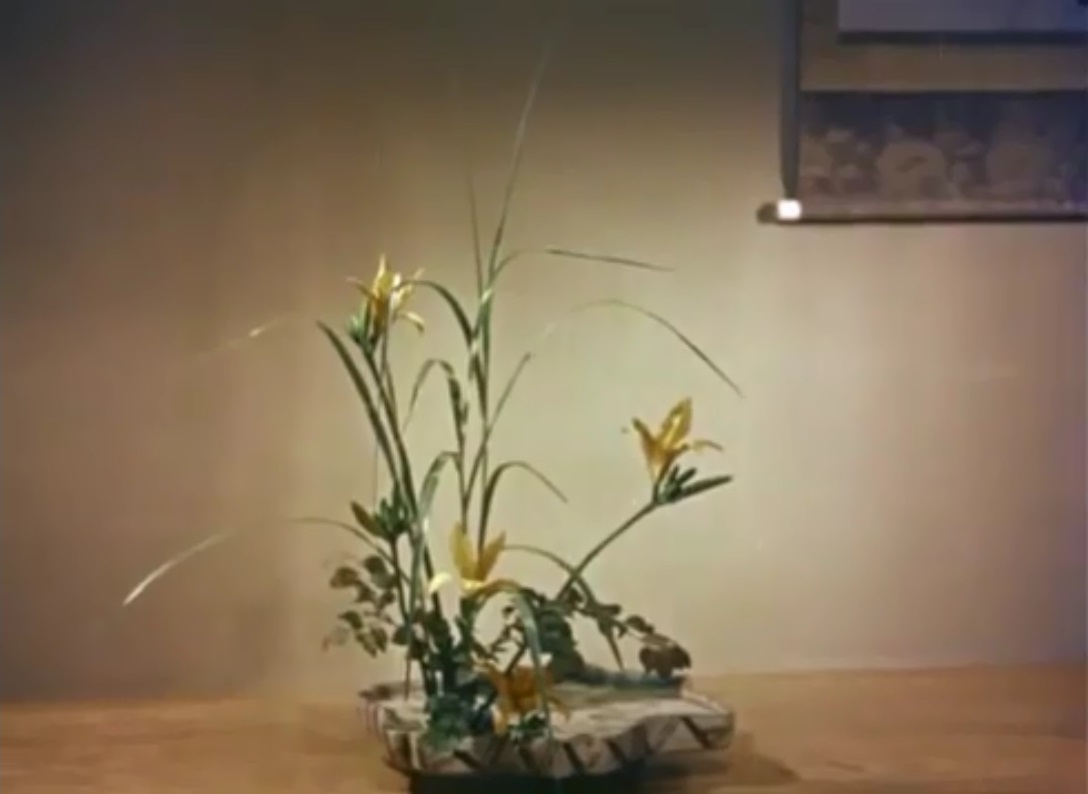
Creation of the art. Rival theories,
later developments.
The Sogetsu school.
Sofu Teshigahara.
Pitfall
Otoshiana
A child stuffs his pockets with candy when no-one is around, the
proprietress of the shop at the abandoned Old Pit mine is dead, first bribed as
a witness to the killing of a “deserter” from the mines who is a
carefully-sought ringer for the head of Union No. 2 (the Old Pit faction,
formed by the corporation to “divide and conquer”), the suspect is
the head of Union No. 1 (New Pit), whose counterpart and rival therefore stands
to gain, the two kill each other near the dead proprietress murdered as bait to
them both, the assassin in white suit and hat and gloves and ultimately shoes
rides off on his white motor scooter with leather briefcase in hand
“exactly as planned”, ignoring the wrathful or entreating ghosts
around him, the child runs down a barren dirt road amid slag piles away from
the uninhabited mining town.
A play by Kobo Abe filmed by a director who has both feet most
ably and most firmly on the ground he’s surveying. The proprietress is
first seen using chopsticks to pluck ants from sweetmeats into a bowl of
liquid, a hot job for an idle day.
Vita
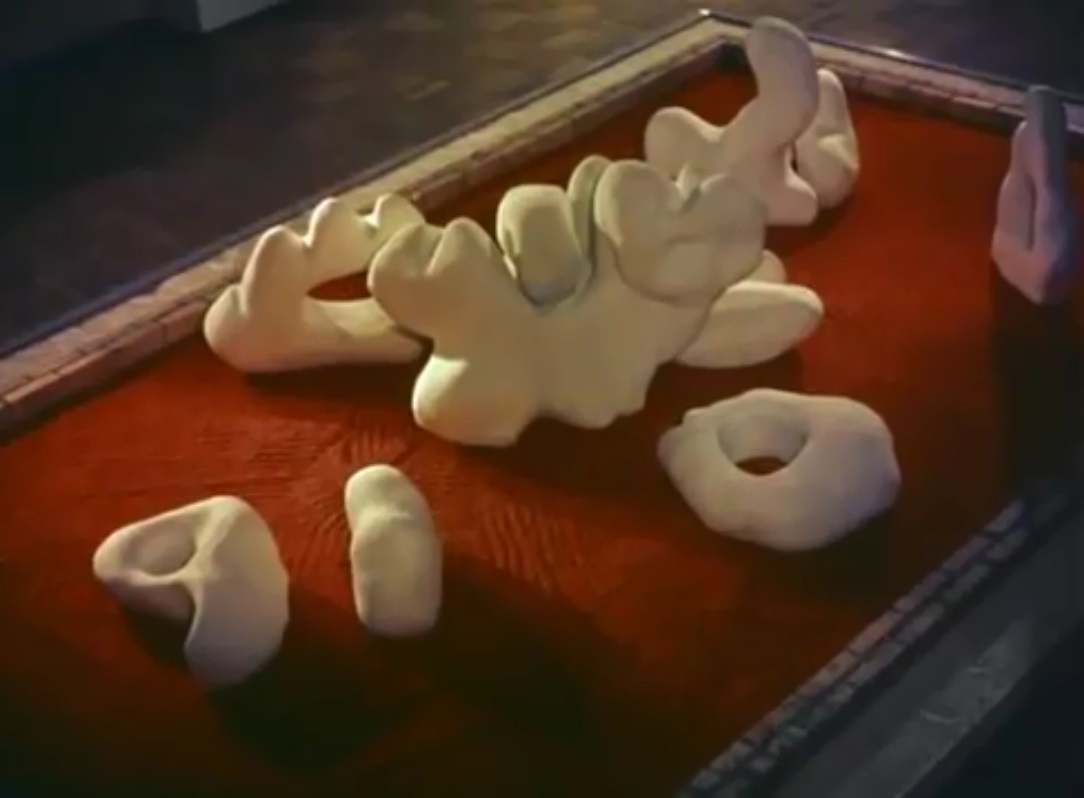
Sculptures by Sofu
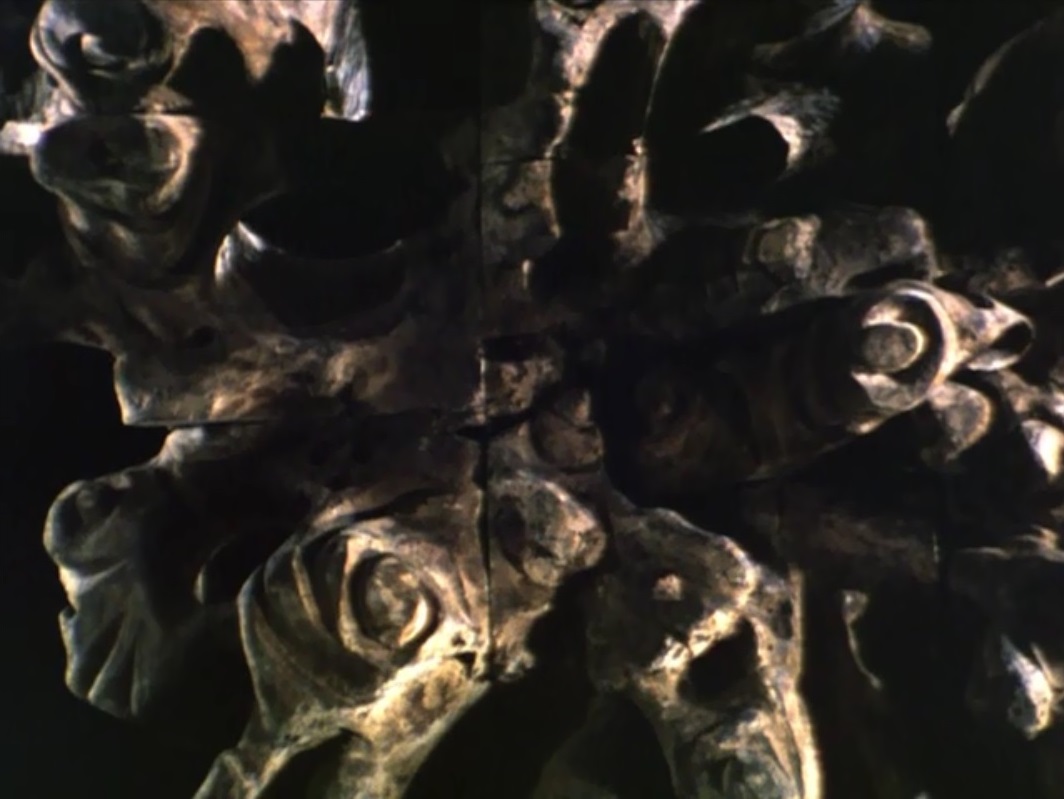
Monochromatic installation footage (Sofu
Teshigahara supervising). Color
views of the exhibition.
Analysis according to certain principles set forth in Ikebana. A
certain limit of expression reached, where the sculptures begin.
Monochromatic studio footage (the artist at work). Penetrating electronic score, quite like the Nō, finally.
Woman
in the Dunes
Suna no onna
The leap of thought from working comedy in Teshigahara’s
Pitfall goes, “when Adam delved and Eve span, who was then the
gentleman?”
The hallucinations of critics persistently imagine a documentarian. Kobo Abe’s sacred horror of masks and
fantasy is scouringly realized here and in Tanin no kao, but
the function of realism is different in both cases. The Biblical text of
Genesis for Woman in the Dunes must be understood and expressed as
knowledge and not criticism, therefore it is not a parable but a record of
experience that represents the whole of human progress from the first (in The
Face of Another, realism is Beckett’s “grace, not cark”).
Teshigahara is a student of
Keaton, His Wife’s Relations, for example. The narrative is
kindred to such films as The Ballad of Cable Hogue (dir. Sam Peckinpah)
and Groundhog Day (dir. Harold Ramis). “I
won’t die like a dog,” says the trapped entomologist as desperate
as George Bailey, the line evokes Welles’ version of The Trial,
the joke about having a girl in your room.
Ako
Kobo Abe’s dream of a dreamless girl of sixteen
(“they’re the opposite of truth”).
The title is translated as White
Morning, so you have the virginal image corresponding to Malle’s Black Moon.
Ako and her friends, charmers, little
beasts, overgrown children, immature adults, flashes of wit, daily jobs, a
sojourn by car (“anywhere far”) not unlike the seaside excursion in
Schlesinger’s Billy Liar, given
per contra the impermeable reality
(Borges’ Poe, “este otro”, the joke is in Waiting for Godot, Estragon’s
“this one is enough for you?”).
The
Face of Another
Tanin no kao
The Invisible Man (dir. James Whale) is seen and mentioned.
“Some monsters want to look like people, and vice versa.”
Hitler addresses the crowds at Psychiatric Ward No. 2, where
vaguely military types go through the motions.
“It doesn’t matter. Men don’t have wings, no
matter how high they climb, they always come down again.”
A thoughtful enterprise averse to Thoreau’s dictum about
new clothes.
It begins where everything else leaves off but Les Yeux sans visage
(dir. Georges Franju), with a disfiguring accident. After
the more than significant loss of face, a psychiatrist conducts a
dangerous and illicit experiment. His specialty is prosthetics that salve the
mind, he fashions a lifelike mask that must be supplemented with a false beard
and dark glasses but is otherwise perfect. The features are molded from the
face of another paid ¥10,000.
It’s tried out at a “München”
beer hall. The main project envisaged by the patient is to seduce his own wife.
He is successful because she is not fooled, his despair provokes the rift that
is final. One might have pretended, she says, but makeup is for women. The last
scene takes place outside a theater. Nemerov has
|
The vacuous
expressions of lovers, mourners, children and pregnant
women, people asleep, racial and sullen and
strange and sullenly at ease as African faces or
roughly featured stones with looks eroded in
the rain of time |
for concertgoers while the music plays, Teshigahara
pictures the strange nightmare of a Japanese playwright, Kobo Abe’s
nearly-faceless audience emerging onto the street not far from Rod
Serling’s doctors and nurses in “Eye of the Beholder”
(“The Private World of Darkness”, dir. Douglas Heyes for The Twilight Zone). Patient
kills psychiatrist, now unknown and free, a man who is nobody yet part of the
picture (Teshigahara’s department-store
snapshots earlier on give just this image).
The mask is deployed fearlessly in its first application at the
psychiatrist’s office with a handheld camera that also mirrors Bruce
Geller’s Mission: Impossible. A poor
stooge buys a wig and beard to swell his image on The Alfred Hitchcock Hour
(“Wally the Beard”, dir. James H. Brown), Keaton’s revolving
hats are shown in the rapid alternation of chinwear. The remembrancer of Sekely’s Hollow Triumph (The Scar) is remembranced, and so are the facial exercises in
Godard’s À bout de souffle. Borges has an Asterion like
this, “my beard itches me under this mask.”
A parallel figuration, the scarred girl and her older brother,
goes still further to prepare the ground for Kurosawa’s Rhapsody in
August. She does the laundry at Psychiatric Ward No. 2 and fears another
war, he comforts her disastrously.
The
Man Without a Map
Moetsukita
chizu
The disappearance of a man, an investigation ordered by his wife
and paid for by his brother-in-law.
The private detective learns nothing and is beaten up for his
pains, following the murder of the brother-in-law, a pimp on the homosexual
side and blackmailer.
An ukiyo-e detective
story, a film noir in color and widescreen, set according to the English
subtitles in 1943, but filmed in the present.
Sculpture
Mouvante
Jean Tinguely
The artist’s works, the artist at work.
Teshigahara had the
occasion of Tinguely’s 1963 exhibition at the
Minami Gallery in Tokyo. “As was his custom, the artist executed his
sculptures on site in Japan, especially for the exhibition, using materials he
found there.”
Nevertheless, this short but illuminating and fortunate film
bears the date of 1981, when it is said to have been shown on Japanese
television.
Antonio Gaudí
The story is, J. Paul Getty didn’t want to leave Surrey to
view the copy he was building of the Villa dei Papyri
for his paintings and sculptures and decorative arts, so he sent a film crew to
California. You want to see Gaudí’s work for
yourself, Teshigahara is your man, the master artist
and logician who films what he sees and knows what there is to know about his
subject.
Thorny problems are elucidated, a mass of wrought-iron on an
apartment terrace is revealed to be in advance of John Chamberlain, a Baroque
ornament is identified as mosaic tile in continuous abstraction which as always
for Gaudí as with Sam Francis and Bram van Velde is significant natural form, grading so insensibly at
times via late Michelangelo and Noguchi into the thing itself that Teshigahara films that too for admiration.
The other point is Max Ernst, Henry Moore and Guimard. The milieu is Picasso and Miró, round dances in
the plaza are deprived of music in one shot (à
la Russell’s Mahler) to give the form.
Available lighting is consciously made use of whatever its
limitations on a given day, there is no trickery or beautifying, Teshigahara is not a Nippon TV newscrew
on a junket. Frescoes of martyrs lay the scene, a village church, early
architectural renderings by Gaudí. The works speak
for themselves until the Sagrada Familia
is supplemented with notes from an acquaintance.
Teshigahara ascertains Gaudí’s true position as one of the greatest
architects of the twentieth century, one who combines Wright and Sullivan, Le
Corbusier, Mackintosh and Kahn in varying degrees, whose artistic purpose and
fertility of invention are unstinting. The magnitude of the works is really
seen and understood, the camera on its dolly is reflected in an opening door.
Rikyu
The tale of a tea master in the sixteenth-century wars, one
student is beheaded, another has plans for China.
The exactitude of the art is such that any frame will be
classical or Teshigahara.
Noguchi and Teshigahara senior are the
dedicatees, a modern sculptor and an ikebana master.
“Not in my cup of tea you don’t,” said Rita Kempley of the Washington Post. Her colleague Desson Howe and Vincent Canby of the New York Times
were gracious enough nearly to call it a masterpiece, with reference to
Chaplin’s The Great Dictator, Huston’s The Barbarian and
the Geisha, and Zinnemann’s A Man for All Seasons.
The central performance is Fuji-san amidst the turmoil.
Gō-hime
The Princess Goh is tamed by a
gardener in the service of Rikyu’s successor as
tea master.
“The disease of Christianity” is spreading. The
seventeenth-century wars claim Oribe as well, he
“opposes the Shogun and furthers the Christians”.
Chapels and portable organs establish a link with contemporary
Europe, the larger plan of the work (as the second of two parts) finds a Roman
fortitude and a Christian knowledge, even John the Baptist gets his say.
The real basis of the tea ceremony and all of Japanese art is
the theme from first to last, with a further sense of Oribe’s
innovations.
At the same time, the style is not so pure as Rikyu, leaving a slight question to go with the
remedy proposed, which is nevertheless veritably the “flower moon”
arrangement devised by the master arrestingly at the start of the earlier film.