The easy rise of a gang boss from robbery and
murder to the whole Northside and the city before him. He
still keeps his hand in. The chum of old leaves the gang for a
dancing career, and that sets up the final image of the gangster shot through a
billboard for the act.
Mordaunt
Hall of the New York Times considered Fairbanks “miscast”,
but Robinson “wonderfully effective”. Variety,
“a swell picture”.
Five Star Final
“I’m not paid for opinions,” says
the Evening Gazette editor’s
secretary, ten years before Citizen Kane. Question
of a publisher’s intentions, “human interest” drives
circulation, “politics and tariff stuff is the bunk.” Rumi’s offal, the editor washes his hands all day
long but serves it up. “I think you can always
get people interested in the crucifixion of a woman,” says the secretary. “LOVE
NEST RAIDED”. John Osborne has this sort of
thing in The World of Paul Slickey,
the Voorhees case (“she shot a man twenty years ago”) comes up
again in Dieterle’s I’ll Be
Seeing You. “Does it point a moral?
It’s a great big wicked city, we can’t be alone.”
Andrew Sarris (The American Cinema)
insists, “as long as he is not mistaken for a serious artist...”
Frankenstein’s monster shows himself a great actor as Isopod. Fuller
remembers the newspaper wars in Park Row.
The Inquirer’s bulldog goes to
press when it hits the stands, the title.
Mordaunt Hall of the New York Times,
“’the production races along without a desultory instant.” Variety,
“a bit of symbolism inserted in the picture is, for once, a help.” Dave Kehr (Chicago Reader), “long stretches
of melodrama.” Tom Milne (Time Out), “Victorian melodrama.” Leonard
Maltin, “sometimes falls apart”. Halliwell’s Film Guide,
“dated but still powerful melodrama”.
I Am a Fugitive
from a Chain Gang
Rosenberg’s complete analysis of this as Cool
Hand Luke leaves nothing to be said, except to point out some small
particularities. Aboard ship, a Texan in the Sunset
Division returning home from France remarks, “if anybody says
‘inspection’ to me, he’s gonna be S.O.L.,” an early
record of this slang term. At the depot in Lynndale,
after James Allen has expressed his idea of a homecoming, LeRoy sets up his
shot so that a building is partially obscured in the background, with only the
letters “MOOT” visible on its signboard. Hitchcock
said to Truffaut, “do you remember, in The Man Who Knew Too Much,
there’s a scene in the dentist’s office? At
first I had intended to do it in a barbershop, with the hot towels masking the
men’s faces. But just before the shooting I saw Mervyn LeRoy’s I
Am a Fugitive from a Chain Gang, with Paul Muni, which has a scene just
like it. So I transposed it to a dentist’s office, and while I was at it,
I changed a few other things I didn’t like.”
The later depot scene, after Allen has escaped and
bought a new suit of clothes, is remarkably like The Great Escape.
Gold Diggers of
1933
The story is very ancient, Judah and Tamar, but
that is only the basis of an overriding metaphor. “If
I forget thee, O Jerusalem, let my right hand forget her cunning.”
Berkeley’s brilliant inventions are what
cinematography can do, and the whole thing goes right into Russell’s The
Boy Friend, with the comedy and the rhythmic structure and the superb
direction and performances.
Oil for the Lamps
of China
The title
might be (as will appear) Lamps for the Oil of China. A
Cosmopolitan Production, “by Alice Tisdale Hobart,” says the main
title. LeRoy goes still further and half-a-dozen times
interposes quick shots of the book being read as transitional dissolves, a rare
practice significantly remembered by Robert Stevenson in Jane Eyre.
At the opening,
you are amidst the cream of the 1935 crop, a series of dissolves takes you into
the Atlantis Oil Co. of New York, where an executive is giving a pep talk to
the new men sitting in tiers around a Chaplin-sized globe. The
ideal, he says, is to bring light to China after centuries of darkness, and
this is “the ideal of a man.” Pat O’Brien’s face in
close-up tells a whole story in the suggestion of a sigh.
And it’s off
to China, with the look of Von Stroheim’s Greed and the feel of
Sjöström’s The Wind, for a brittle introductory scene that starts
numerous threads running through the film. LeRoy then takes off into an
ascending series of episodes that lift the weight of the novelistic apparatus
from his delicate theme, the first is set in Yokohama (Teru Shimada is the
teahouse proprietor), with a Butterfly effect from the musique de
fond, a subtle distinction in O’Brien’s view of the
sophisticated Japanese, and a foreglimpse of Huston’s The Night of the
Iguana.
Gradually the
theme is revealed to be very similar to and almost a prefigurement of Satyajit
Ray’s in Company Limited, which may be stated as the power of
inspiration in a corporate structure.
Office politics in
New York are described as dictating company policy in China.
O’Brien’s loyalty is shown in a difficult scene evoked by George
Stevens for Penny Serenade. O’Brien’s savoir faire is
a natural rapprochement based on study and appreciation of the Chinese
and their culture. Josephine Hutchinson rounds out the trinity of thought,
“two things matter to a man—the woman he loves and the work he
does.”
Even in drought,
famine and cholera, O’Brien must fill his quota, but “God was good
to us, even if China wasn’t.” O’Brien’s Chinese
counterpart Ho says, “the company is to you what my ancestors are to me.” O’Brien tells his wife, “it’s my
identity, it’s my work, it’s me!”
The Communist
onslaught brings on an amazing gag when a staff car knocks a mule-cart off the
road. Tony Gaudio’s lustrous cinematography (he shot The Adventures of
Robin Hood, The Letter and The Red Pony, among other notable
films) has a few beautiful effects, like Ho racing to the rescue in a rickshaw,
floating swiftly through the scene.
Ho is shot down.
O’Brien (briefly contemplating a laughing God) rescues the office monies
from expropriation and is wounded, without benefit to his prestige. The
company’s new regime opposes a tyranny of “the highest
bidder” to O’Brien’s recognition of “face and tradition,”
and he is passed over for promotion as “not progressive enough for the
new regime.” The practice of forcing out senior staff to avoid paying
pensions is shown to have been commonplace even then. But, says Hutchinson,
“happiness is bought—and we’ve paid for ours.”
O’Brien’s invention of a low-cost kerosene lamp given away to the
local population has been appropriated by a higher-up, but she reveals the
patent is his, and the company president reinstates him as the most qualified man
for the job, anyway.
“So you
see, honey,” he says, “the company does take care of its
own.” “Yes, dear,” she
answers.
The New York
Times complains that “it presents the Chinese Communist movement as a
vulturous gangsterism,” which aside from proving Gore Vidal’s point
about the Times (“a bad newspaper”) misses the beauty of
Keye Luke’s swift performance as the British-trained Communist officer
sent to confiscate company funds. “We’re in a time of social
changes,” he says, “and social changes cost money.”
They Won’t Forget
The nominal form
is a consideration of the Leo M. Frank case, fictionalized.
The structure has
three areas or modes to consider, the first two of which have been noted by
reviewers, who all cite Lang’s Fury as a precedent on lynch mobs,
some note the analysis of press corruption and political malfeasance without
citing the other precedent, Milestone’s The Front Page, these
aspects go together.
The main concern,
witness the title and the opening quotations from Lincoln and Lee, is a
hardening of the Southern mind against the institutions of the North, a war
still waging. This has been overlooked by critics, successive films have taken
up the rather more obvious themes, LeRoy probably has
an eye toward the European situation as he deals with a particular sectionalism
in this way.
Waterloo Bridge
Between Whale and
Bernhardt, between Camille and Anna Karenina, the one about the
soldier in France and the girls on the home front, remembered on the day that
Britain entered the war against Hitler.
Crowther (New
York Times) found no merit in the anecdote, but praised Vivien
Leigh’s performance.
The lights going
out are famously evoked by LeRoy at the Candlelight Club from Haydn, Pauline
Kael’s comment was “the director uses candlelight and rain more
effectively than he does the actors” (cited by Halliwell, who describes
the film as “lush, all-stops-out”). For Variety, “a
persuasive and compelling romantic tragedy.” For
Time Out Film Guide, “purest corn, of course.”
Escape
LeRoy directs
this for the significance of it, rather than to dramatic effect. This accounts
for the discrepancy between reviewers then and now.
Cukor is supposed
to have been dropped after filming with Paul Lukas, then Hitchcock refused, and
LeRoy hired Conrad Veidt. This requires clarification.
Most of the film
is handled as described, with a flatness tempered by commentary from a barman
or a waiter, until the great café scene initiates LeRoy’s involvement,
with a complex camera movement. His two “political policemen” enter
the café and question Taylor extensively, and this is
the first effect sought by LeRoy after establishing the general uneasiness of a
police state. “This isn’t a country, it’s a Coney Island
madhouse. A door looks like a door, until you try to
walk through it. People look like people, till you try to talk to them, then
something squirts in your eye.” The essential characteristic of the
situation is the domination of the individual by the state, as revealed in the
scene with the police commissioner. The door to his office has three lines
elegantly set above the lintel, “One People, One Realm, One Leader”. If questioned on state policy concerning the arrest and
murder of a citizen on factitious charges, the commissioner demands to know the
source of the questioner’s information.
The second effect
was sought in the first place. Nazimova’s coffin is carried in darkness
with her inside it still alive, the sequence laying the political police over
an image of Poe’s “The Premature Burial “ or “The Fall
of the House of Usher”. Cukor’s sequence,
which must be the Countess’s palace immediately following (despite Conrad
Veidt’s presence), is a beautiful piece of moviemaking that shows the
cast and settings to best advantage and removes all doubt as to the abilities
of Taylor and Shearer. Mayer probably fired Cukor for
just this reason. LeRoy knocks the whole film into a
cocked hat. “I’ve had it up to here,”
says Taylor, making the salute of the One Leader. There is a monstrous story to
be told, he tells it monstrously. René Clément’s Is Paris Burning? has something of the same idea,
and the ending is modified to serve in J. Lee Thompson’s The Passage. Kipling is cited. “We meet
in an evil land / That is near to the gates of hell.” The
title anticipates Casablanca in a way by its secondary reference to the
love affair of the Countess and the General.
Johnny Eager
The second theme
of Little Caesar is now a literary one, a third is added from
Capra’s The Power of the Press, a more
complicated picture emerges of the fix in the big city.
“Lacks purpose”
according to T.S. of the New York Times. Variety
has “underworld meller”, Tom Milne (Time Out Film Guide)
something “nothing can salvage”.
Random Harvest
A sublime joke,
echoed by Ritt in Stanley & Iris. Shell-shock
case meets girl, turns scribbler, gets a position, a taxi runs him over and he
remembers himself, lord and master of Random Hall, he takes over the family
business with some misgivings and makes a fortune. Why, he even stands for
Parliament, with the Liberals, quite forgetting the girl, who’s there all
the time.
Another LeRoy
film that the greatest experts on all matters pertaining to the cinema,
professional film critics, have never understood, and that famously includes
James Agee.
|
Under a spreading chestnut tree
The village Smithy stands. |
You, John Jones!
It comes to him
forcefully, after a day at the war plant making P-38s, doing his duty as air
raid warden of an evening, just exactly what the war means.
A unique and
terrible reel of film from the War Activities Committee of the Motion Picture
Industry.
Madame Curie
Introduction at
the Sorbonne. Early lab work. Engagement
and marriage.
Becquerel’s
photographic work with pitchblende provides the key. Endless refinements later
there is radium.
“Every inch
a great film” (Variety). “Among the ten best films of the
year... a high accomplishment on the screen” (Bosley Crowther, New
York Times).
Shakespeare’s
incandescence, in Virginia Woolf’s phrase, is certainly evoked.
Thirty Seconds Over Tokyo
Raid on a
smelting plant, Doolittle, 1942.
The metaphor is marriage, it costs the bridegroom’s leg, his left.
All kinds of
problems with the Ruptured Duck, left engine, top turret, interphone.
It sinks just off
the China coast.
The pilot always
wanted to be an aeronautical engineer, anyway. A
masterpiece of the cinema all the way, from Trumbo’s screenplay to
LeRoy’s filming.
The House I Live In
“Nazi
werewolves” right outside the recording studio get a stern talk from Frank
Sinatra, and the title song.
Homecoming
The dull, dreary,
appalling toil of war has but one aspect to commend it, a Circean muse, the vision of judgment.
East Side, West Side
The terribly difficult
construction of this was entirely lost on Bosley Crowther of the New York
Times and therefore “just about hits the low-water mark of interest,
intelligence and urgency.” It can most usefully
be compared on the dramatic side to Bergman’s Lubitsch comedy A Lesson
in Love. One rises in society, it may be, with the
years, certainly a famed actress with a daughter married to an investment
counselor, who is unfaithful. The actress, played by
Gale Sondergaard, is a minor character who appears once to set up the scene at
the beginning and once to conclude it at the end, the single most important
character after all. Her fascination for the husband
is projected onto a love affair that ends fatally, the actress’s contempt
is so complete. The daughter leaves him, her love
ceases at once. A major psychological problem treated or anyway presented thus
far, and Variety did not divine it either. It
means nothing in Halliwell’s Film Guide, where Penelope Houston
says as much, too.
Quo Vadis
Nero’s place
in history is at the center of a court that includes Seneca and Petronius,
Lucan is a guest. They temper his madness with fit judgment and wit, but his
venturesome æsthetics (he is a singer of rotten lays) get him carried away into
the grand symbol, the objective correlative of Rome’s ruin, philosophized
over but made manifest in the burning of Rome for a Neropolis in his own image.
Million Dollar Mermaid
Méliès is
directly invoked for the underwater ballets, but the overall image is one
devised by Hans Richter and given to Busby Berkeley’s choreography.
It opens with the
awful, tragical news that New York’s Hippodrome is a thing of the past.
These wastrel times, as if keeping a building were less than constructing it! A
sequence of shots follows the credits that unfolded for Ken Russell, François
Truffaut and Federico Fellini. The spirit of Charles Dodgson is invoked for the
passage down the Thames. 2001: A Space Odyssey (dir. Stanley Kubrick)
remembered Kellerman’s first press conference.
Attenborough
replicated the Hollywood scenes for Chaplin. Consequences remained for
Hockney and Godard.
The Bad Seed
The little girl
with blue eyes and blond hair braided down in two pigtails kills for things she
covets or to silence a witness, she has no compunction about it,
her death comes on the eve of her next murder, planned for a lady who dotes on
her and can’t see through her.
The structure is
complicated by considerations of heredity, it’s happened before, but by
the time Leroy the janitor is heard screaming behind locked doors in his cellar
on fire, let alone the famous bunker ending, the significance of the childish
sociopath has been made plain, and yet to one’s utter astonishment even
young Truffaut had no idea what it was all about and fulminated like Bosley
Crowther of the New York Times and every other critic from that day to
this in a very humbling lesson for the profession or to gratify the
filmmakers’ wish that the ending not be disclosed.
Toward the Unknown
A complete
analysis of Wellman’s Gallant
Journey, with the author of Twelve
O’Clock High (dir. Henry King) and
Strategic Air Command (dir. Anthony
Mann).
The title is Ad Inexplorata, Glenn Edwards’ portrait is
seen.
Critics such as
Bosley Crowther of the New York Times
having failed with the earlier film failed with this (Time Out Film Guide, Halliwell’s
Film Guide, “humourless flagwaver”, a favourite phrase).
no time for sergeants
There is only one
Mervyn LeRoy, no other director would have and could have handled the material so
successfully. A number of great films might have been made of it, but none like
this, LeRoy having estimated it so justly. A most unexpected service comedy
with an A-bomb in it and Cline’s Private Snuffy
Smith behind it.
USAF draftees
include a Georgia man from the piney woods who upsets the rotten apple cart
with his obliging ways so terrifically he wins a medal and a transfer to the
infantry, which is what he wants, it’s where the
real fighting is done.
It turns into
Nichols’ Catch-22 before too long, but nothing is more savage and
complete than this all-pervasive satire, it’s even ahead of
Stevenson’s The Absent-Minded Professor in the two generals’
momentary hesitation before the medal ceremony, “too many
witnesses”.
LeRoy takes his
time like a country mule, basks in every moment, invents a new style, pays
attention to every detail, minds every minute, lets the thing speak for itself,
can hardly believe his good fortune, congratulates everyone, smokes a good
cigar and goes to bed, “satisfied with great success”.
The casting is
very careful and exact, like the direction and everything else. “The
goddamn Air Force”, as Altman would say.
Home Before Dark
It is quite a
classic study from Ibsen perhaps, and as a technical point simply shows how
from Rebecca or Suspicion one arrives at A Woman under the
Influence, though LeRoy’s construction is typically massive and
complex to such a degree that criticism as generally practiced is rendered
superfluous (Bosley Crowther and Halliwell’s Film Guide found the
thing literally meaningless, Variety somewhat less so).
The FBI Story
KKK, land sharks,
hoodlums, Nazi spies, Communist spies, an unusual case beginning the mundane
lecture to new agents, one combining insurance fraud and mass murder.
The whirlwind of
crime, the slow, steady pace of the Bureau.
Crowther of the New
York Times was quite averse to this, Variety not so much. Halliwell
was bored, the Monthly Film Bulletin is cited
by him, “insufferably cosy.”
Capra’s It’s
a Wonderful Life is a steady reference, Ford’s
The Man Who Shot Liberty Valance shortly follows the attack on a
small-town newspaper.
The Devil at 4 O’Clock
Teatime. An allegory of the war, with that famous account of a
pogrom at a Jewish children’s clinic.
Weiler of the New
York Times could not reconcile it, Time Out Film Guide scoffed.
Nevertheless, one
of the great works of the cinema.
Gypsy
The story goes
that Stravinsky received a telegram during the run of The Seven Lively Arts
in New York, GREAT SUCCESS and all but better with a reorchestration of his
ballet, and that he wired back SATISFIED WITH GREAT SUCCESS.
Mary, Mary
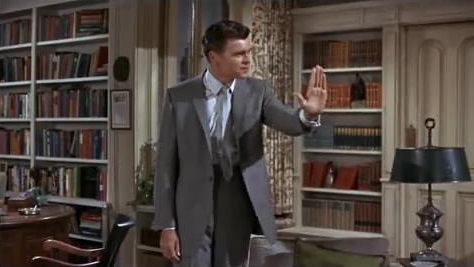
“I can
think of only one sure way to clean up in this business, a new series, I’ll
take the great sex novels, Lady
Chatterley, The Chapman Report,
have ‘em rewritten for the ten-to-twelve age
group.”
One of the
pillars of Woody Allen’s Husbands
and Wives (cp. Manhattan Murder
Mystery). The playwright’s riposte to the
critics, “well, it’s not uneven.”
Pure LeRoy, the
divination of infinite variety across a living room set (and, briefly, dinner
at Chez Roberto in “the silliest snowstorm you ever saw... look at those
big flakes swirling around, they look so phony”).
“I’m
worried about Philadelphia.”
“Well, I
guess most people are.” Then there’s the fellow with Frost’s
oil lamp you swerve to avoid who warns you to stay off the soft shoulder,
“you’ll never get out.”
“Like who,
for instance?”
“Like—like
Carl Sandburg, for instance!”
“You don’t think Carl Sandburg is
beautiful?”
“I want
something guaranteed not to improve my mind.”
“Who’s
your decorator, Vic Tanny?”
“You heard
of The Lost Weekend? Well, this is
the found weekend, and it’s
worse!”
“You know
there’s something very mysterious about your feeling for Mary? It’s
like gas, you can’t get it up and you can’t get it down.”
“Oho,
there’s a touch o’ the poet in you.”
“You know,
if you repress things, eventually you become devious.”
The publisher and
the wit, their lawyer, the middle-aged actor and the health food nut. Everything but the kitchen sink and that briefly, too, and
the bedroom.
Bosley Crowther of the New
York Times, “all that happens is that five determined persons exhaust
themselves in talk.”
Catholic News Service Media
Review Office, “director Mervyn LeRoy does little with the static screen
proceedings, allowing the play's comic banter to turn into leaden exchanges
that throttle the possibility of finding any charm in this sentimental tale of
a divorced couple's reunion. ” Craig Butler (All Movie Guide), “a diverting
little piece of fluff.” Halliwell’s
Film Guide, “feeble... the camera asleep in the stalls.”
Moment
to Moment

An answer to Sagan’s Goodbye
Again (dir. Anatole Litvak), particularly elegant.
The opening
sequence figures handsomely in Chabrol’s La Fieur du mal.
The grace and
simplicity are an English virtue, from Hindle Wakes (dir.
Maurice Elvey or Arthur Crabtree) to The V.I.P.s (dir.
Anthony Asquith).
American artist
dead at Cannes, a Navy man, Greek, only a flesh wound, amnesiac, perhaps a jest
at Truffaut for one hell of a bad review (The
Bad Seed). The statue at Mougins here goes
similarly unnoticed, in a way, but there is horse racing, and modern art is a
puzzle (Fondation Maeght).
A tour de force for Jean Seberg aping
Barbara Rush and Tippi Hedren
most marvelously, neck and neck with Honor Blackman as the grass widow next
door, Arthur Hill, Sean Garrison, Grégoire Aslan “in the running”
so to speak.
Stradling cinematography, Mancini score, Mercer lyrics.
New York Times, “if only Mr. LeRoy had run a tight wire through his handsome production.”
Variety, “doesn’t entirely jell”. TV Guide, “standard suspense
film”. Craig Butler (All Movie
Guide), “a very bad movie.” Halliwell’s
Film Guide, “malarkey”.
A particularly
elegant analysis in the long run is Cassavetes’ A Woman under the Influence.
The title
describes a relationship to Tennessee Williams’ Boom (dir. Joseph Losey).