Wabash Avenue
How the other
half lives, onstage prelude “I Wish I Could Shimmy Like My Sister
Kate” (cf. Griffith’s The Painted Lady), main theme I Walk Alone (dir. Byron Haskin). “Don’t raise the bridge, boys, just lower the
river.”
A source of Robin and the 7 Hoods (dir. Gordon
Douglas). Billy Daniel’s choreography just
anticipates Bob Fosse’s earliest film work. “Well,
you see, taste is something either you have or you don’t have, you never
quite learn it.”
“I’ve
got half a mind to take a baseball bat and re-educate you.”
“You’ll
never know if an apple is sweet,” the girls in the chorus line sing,
“unless you bite it!” Koster of Berlin,
son of a salesman in the ladies’ undergarment line. The
C.C.C.C. up in arms, “I wanna be a nice girl, why
won’t they let me?” A capital flying
fistfight remembered in Blake Edwards’ The Great Race. Reunion at the Chicago
World’s Fair, “look, sister, the professor and me is rehearsing,
now why don’t you blow on outta here before I
lose my temper.”
“Ho-ly Moses, where’s your horse?”
“I’m
looking at part of it.” Taming the star
performer, cf. Hawks’ Twentieth Century. The
director’s art, “the scales fell from my eyes” said Ralph
Richardson when Gielgud directed him as Caliban. The little Ferris wheel
at the Fair, “I can’t help it, sailor, I got a girl up there.”
“I don’t
care if it’s the Queen o’ Europe, quit rockin’,
makes me seasick.” Prerogatives of the lady, “I
Always Dream of Bill”. The Irish dancing master,
central figure in a thematic line from To
Have and Have Not (dir. Howard Hawks). Gambit and ploy,
ruse and counterruse.
|
Wilhelmina, she’s the cutest little girl
in Copenhagen. Wilhelmina, she has all the fellas
crazy in the noggin, in Copenhagen. |
Charles Walters’
The Barkleys of
Broadway was just the year before, Cukor’s Born Yesterday premiered that same year, and his My Fair Lady some years later. The star in her niche. “A
skunk can’t really hurt you,
just humiliate you.”
“Only when
he’s cornered.” An artist with the skids
under him, traduced, marking time. The thematic
summation, from City Lights (dir.
Charles Chaplin) to Singin’ in the Rain (dirs. Donen &
Kelly).
Bosley Crowther of the New
York Times, “just a few points shy of perfect, so far as these honky-tonkers go.” Variety, “a satisfactory backdrop
for the deluge of tunes”. Leonard Maltin, “bright, colorful period piece”. TV Guide, “certainly
has its moments of charm.” Catholic News Service
Media Review Office, “thin but lavish musical”. Hal
Erickson (All Movie Guide) goes off
the rails incredibly, “once she reaches the top in a Hammerstein show, Ruby's
head is turned by Clark's suave, sophisticated partner English Eddie (Reginald
Gardiner).” Halliwell’s
Film Guide, “bright rehash”.
Harvey
The literary
precedent is Edith Wharton’s “Xingu”, Kershner’s A
Fine Madness is an invaluable analysis. “Something
new has been added,” and on this there are said to be “two schools
of thought”. Therein lies the drama. Certain
critics are very fond of drama. The Pulitzer Prize was never given to a
worthier work. A perfect masterpiece, perfectly filmed. In
this instance, the critics have never had any idea of it.
No Highway in the Sky
The thrust of it
is, if one may say so, the end of a marriage already finished by a V-2. No Highway, Goodbye Mr. Chips (dir. Sam Wood or
Herbert Ross). “I didn’t understand his
theory, but I know when a man knows what he’s talking about.” The film star is a great ally, she carries on. The stewardess and RN takes charge of the cabin where Mr.
Honey, a metallurgist with interests in numerics and crystallography
(pyramidology is a game), works out an utterly abstract theory of metal fatigue
affecting the tail section of a commercial airliner recently gone into service.
O. Henry’s Full House
“The Cop
And The Anthem”, a flabbergasting masterpiece on
a fellow (Charles Laughton) who but for the grace of God can’t get
himself arrested to save his life.
Stars and Stripes Forever
A fine bit of
surrealism on The March King. “A real old-time
Marine for you” is liable to get kicked in the shin by a burlesque
number, but “women treat those ferocious cripples back from hot regions.” He is successful and universal, a genius, a soldier,
a man of the people, Your Own, The President’s Own, The Marine
Corps’ Own.
Several brilliant
sequences around Paget, Wagner’s musical Marine, Hussey’s perfect
wife and Webb’s Sousa.
Bosley Crowther
of the New York Times, “nothing
more” than a “program of Sousa marches”. Variety, “topnotch
entertainment... kaleidoscopically presented”. Catholic
News Service Media Review Office, “episodic”. Dave
Kehr (Chicago
Reader), “a so-so Fox musical”. TV Guide, “lively and
colorful”. Hal Erickson (All Movie Guide), “highly fanciful”. Halliwell’s Film Guide,
“low-key musical biopic with predictably noisy numbers.”
Ernest Vajda story, Lamar Trotti
screenplay, Charles G. Clarke cinematography, Alfred Newman in charge of the
music.
My Cousin Rachel
This very
purposely enigmatic film seems to have been made for no other purpose than a
simple juxtaposition of disparate elements, so as to extract (possibly) the
most refined analysis imaginable, short of “a sewing machine and an
umbrella” side-by-side, out-Jamesing Henry James. This
would be Nunnally Johnson’s joke, laid out by Koster with the utmost
attention to surface detail, and acted with just the right soupçon of zest, it
goes into Rosemary’s Baby
(dir. Roman Polanski) as is.
A companion piece
to Hitchcock’s Suspicion.
The Robe
The screenplay notably
rejects the senatorial animadversions of Tacitus for a clearer view. Tiberius is sagacious, putting off soothsayers and witch
doctors. Caligula is very high-strung, you can see the
political interpretations fairly welling up all around him. They
are recognizably human heads of state, for all that.
The tribune
(Richard Burton) is a sensible Roman who buys a slave (Victor Mature) because
the man has spirit, because the market is degrading, and because Caligula has
him in mind as a gift for the tribune’s childhood friend (Jean Simmons). A sensible Roman.
There is a
remarkable scene of volatility exhibiting Percy Helton as a dunning wine
merchant who is flung into the baths, which balances in its unexpectedly
keyed-up tone the furious swordfight between the tribune and a former
comrade-in-arms, the realism and vigor of which in turn evidently served as one
of the sources for Hitchcock of the farmhouse fight in Torn Curtain.
Pontius Pilate
(Richard Boone) is also bereft of angular satire, a soberminded and harried
provincial officer.
It’s the
tribune’s first crucifixion, he is bidden to reflect upon this, and very
wisely takes a drink first. Afterward, the soldiers
are dicing (“a hundred bunks separated by crap games,” as Bob Hope
would say) with a cup, the careless tribune (“I always win,” he
says nonchalantly) accepts the homespun scarlet robe as a last wager.
The
messiah’s coming is sung by Miriam (Betta St. John) upon a harp, to a
Hebraic melody. The robe scalds the very flesh of the
tribune, or anyway sears his conscience, and he is at length converted.
Koster’s
direction can be very profitably studied in the schools. According
to Katz, “his reputation as a craftsman led to his assignment as director
of the first film in CinemaScope, The Robe,” and the limitations
of budget do not deter him from a constant insinuating attention to the
structural details of every shot. Where, the playmate
of his childhood wants to know, is the tribune now? She
is led to the catacombs where the followers of Jesus gather. Koster
films her on the portico of a palatial building, which can just be seen behind
her amid the red marble columns that dominate the shot, conferring with an
associate of the tribune, who leads her down the steps and away.
Désirée
The silk
merchant’s daughter and the General she might have married, Napoleone
Buonaparte, had his destiny not intervened, the founding of “a United
States of Europe”. For Koster, the similarities
are obvious, especially where the émigré Marshal is depicted at the court of Sweden
with his wife, the title character.
A step from the
sublime to the ridiculous is frequently taken by the Emperor.
The film lacks,
in Bosley Crowther’s view, “a story of any consequence” (New York Times).
A Man Called Peter
The compositions
are so perfect that, just once, the dolly reveals how arduous they are by
trundling rapidly between them, after the sermon in Atlanta. Few
directors there are who would not stare agape at the subtlety and power of this. The brilliant surrealism of Stars and Stripes Forever
is adapted to another purpose. The biographical
rendering is a precursor of Ken Russell.
Peter Marshall,
Chaplain of the United States Senate, rises to that position of undoubted
eminence from his divine calling in Scotland, work as a laborer in America, the
Columbia Theological Seminary, a small congregation in Georgia, then a large
one, and the New York Avenue Church in Washington, D.C. (the Church of the
Presidents). In memorable sermons he expounds on
faith, the church, death, the prophetic mission and suchlike matters. Early on, his future wife joins him to speak on Mary with
similar eloquence, while still a student at Agnes Scott College.
A Midwestern
senator changes his vote on a bill, inspired by the forthrightness of
Marshall’s preaching at New York Avenue. The
bill is designed merely to create “a crop of millionaires” at the
expense of small farmers. Its defeat is announced on
the radio news following a report of lessening tensions with the Japanese. Marshall preaches, inspired, an impromptu sermon at
Annapolis, where the chapel must have presented a lighting problem of
Kubrickian proportions. During the war, he runs a
canteen in the church basement for servicemen. His
wife contracts tuberculosis. Rest and prayer on Cape
Cod avail her nothing, only submission to the divine will restores her to
health. Immediately upon their return to Washington,
he is stricken by heart troubles. Asking for divine
guidance on the dais of the Senate finally kills him. He
had been a lover of the sea all his life, though his wife got seasick. After his death, she and their young son and their dog row
out from shore, she addresses her late husband with the title of an Alan J.
Pakula film, “see you in the morning.”
Koster’s
awe-inspiring precision anchors the film at every moment while admitting a
round view of the events. Long takes are a specialty,
the camera not moving any more than it would for William Wyler. The foibles and characteristics of the people represented
are shown in each continuous scene with the idiosyncrasy of the apostles. “Man is but a vapor,” says James, and Marshall
begins a sermon by asking, “what did he mean by that?”
His secretary conveys a message from the senator, commenting,
“what a strange way of putting it.” Marshall
cheerily replies, “Yes, strange and mysterious, like the ways of the
Lord.”
Preminger’s
The Cardinal no doubt remembers this film, which as an American satire
is almost without equal in its profundity and wit, while as the work of a
Berlin filmmaker in exile it presents a clear view of what Germany lost.
The
“‘argument of military necessity’ (generalissimo e)”,
as E.E. Cummings puts it, must be borne, it’s the peacetime wrangling
that kills the minister. His invocations are seen as a
sequence of snippets, followed by dinner at home. “You’ll
have to ask the blessing,” says Dr. Marshall to his wife, “the Lord
knows I’m not grateful for turkey hash, and I can’t fool him.” The film is spoofed in a 1962 episode of The
Alfred Hitchcock Hour directed by Joseph Pevney and called “Bonfire”.
D-Day the Sixth of June
They Were Not
Divided, says Terence Young, and
they were not missed, much.
Bosley Crowther (New
York Times) makes it the occasion of a peculiarly ferocious sneer, the
better not to reflect (O’Brien’s character, timorous Col. Timmer,
gets his vote), Variety is much more expansively responsive.
The Power and the Prize
A blank check to Hitler, who writes himself into oblivion with it, a
view of the war from a business perspective, a stylistic mandate.
This will stand comparisons,
they are odious.
The brusqueness
of the jointures arises from the historical requirements of the story.
The prize is control, power the means to obtain it, the position stands
revealed as weakness.
Wherein power
consists, and what constitutes the prize, are probably psychological
considerations as much as anything else.
Bosley Crowther
was mostly taken with the widow (New York
Times), the rest was good acting and “a somewhat hackneyed
story”, critics crave excitement, it isn’t all fizz and popcorn. “Had far more relevance in 1956 than it does
today,” says Hal Erickson of All
Movie Guide, irrelevantly. Leonard Maltin, “sporadically
effective”.
The Story of Ruth
The Moabitish
splendors pass into the genre-painting of Bethlehem across the widescreen
panoply treated as fresco panels with distinct reference to DeMille’s
geometric handling of The Ten Commandments in a centrally Egyptian
style, for comparison, and later registered by Mankiewicz in Cleopatra.
The dramatic
bounds are those of sacrifice and consummation, Ruth is a priestess in the
temple where children of her sex are ritually given to the knife and
immolation. Naomi’s prayer brings a divine messenger, followed by rain in
the cistern reflecting the faces of Ruth and Boaz.
The exceptional
vigor and clarity of the performances is quite a deliberate study by Koster for
peculiar effects of character, achieved by contrast and relief so therefore pictorial,
in a way.
Flower Drum Song
The extremely
poetic nature of the work is indicated immediately after the Marx Brothers
opening, in “A Hundred Million Miracles”, which continues later on.
Bosley Crowther,
with his customary stupidity, confused the adroit use of stock characters with
a lack of wit and sophistication, and bungled his review in the New York
Times (Variety did no better).
Koster was
miraculously called to film this, he had the best cast and crew and made
something astonishingly brilliant.
American
directors have from time to time dropped their jaws when looking at foreign
films, this time the jaw was on the other floor.
Witness, if you
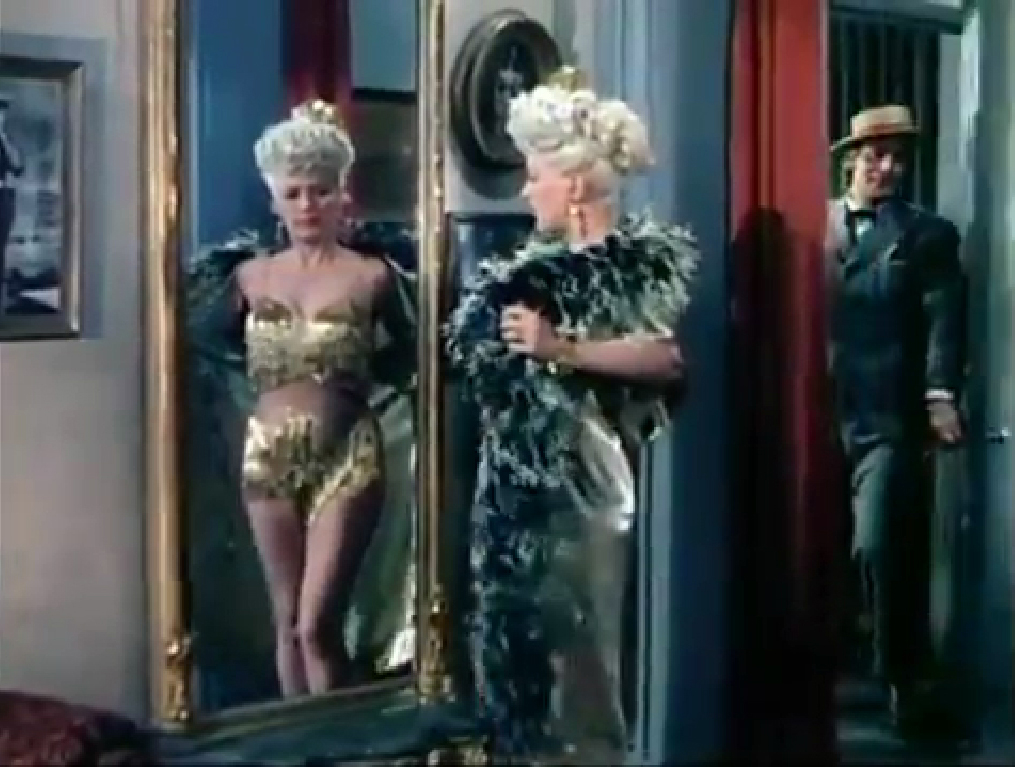
will or no, the nightclub performer in front of her triple full-length mirrors
that individually represent her singing “I Enjoy Being a Girl”,
Irene Sharaff dresses her reflections rather badly, she is Serling’s
“portrait of a girl in love—with herself”, three years ahead
of Jerry Lewis’ backup singers (The Patsy), infinitely subtle.
The abstract
ballet “Love, Look Away”, the crowning surreal
“Sunday”, the variability of Hermes Pan’s choreography, the
nimbleness of every song, the perfect jokes throughout, the touching
performances, the advanced structure, the dancing and wit and humor, just went
for nothing much with reviewers if you can believe it, as if that were
possible.
Mr. Hobbs Takes a Vacation
Koster’s
masterpiece on a comic variation of the last will and testament drawn up and
quartered at the end, by Nunnally Johnson from the author of Minnelli’s Father
of the Bride.
The CinemaScope
pictures are worth the price of admission, the document is a Life with
Father letter dictated at the bank offices in St. Louis concerning a
month-long stay at the sea “south of San Francisco” with wife and
entire family, daughters, sons-in-law, grandchildren and son, also a
son-in-law’s prospective employer and his wife.
It’s a
Wonderful Life (dir. Frank Capra)
is cited, Dragonwyck (dir. Joseph L. Mankiewicz) and Tombstone
Raiders are mentioned, Mankiewicz’ The Ghost and Mrs. Muir is
evident on the set.
“Did you
see that fellow that fell on his face?” That was Jonathan Rosenbaum of
the Chicago Reader.
Dear Brigitte
An æsthete to the
manner born, Robert Leaf, professor.
|
The
slender birch in which the linnet rests Is a promise made in
quiet splendor Heard above the drums
of thunder, For silence is the
shriek of life. |
These verses of
his are recited to their author by a con man and professor of Elizabethan
studies, Whitman is mentioned by way of compliment.
Leaf’s son
is eight, “tone-deaf, color-blind”, with a capacity for numbers
that is prodigious, a genius of analysis, and the goal of all the lad’s
striving is Brigitte Bardot, who recites these lines of the poet’s to
their author,
|
The songbird’s
flute, The
drumbeat of the rain, The sound of wings
against the night, All join to put my
heart to flight. |
The Singing Nun
Koster underplays
this consistently to his heroine, who becomes in her professional capacity a
luminous apparition of convent wisdom and a very effective symbol of the artist
himself, hence the transmogrification of the final scene in an African village,
the sudden displacement has its surrealistic uses, may be seen as an honor to
Sœur Sourire out of Eliot’s The Cocktail Party, but is
directly understood at once in itself.
Variety and Bosley Crowther were disappointed.