The Canadians
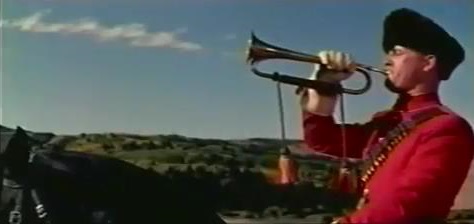
After Little Big
Horn, the Sioux head North.
The Northwest
Mounted Police, “without whose help Canada could not have
survived.” A tenuous position magnificently portrayed in every detail,
the voice of sweet reason pleading and prevailing.
Superintendent,
inspector, sergeant, constables, under canvas in the wilds of Saskatchewan and
very much under the sign of John Ford not long after Gideon of Scotland Yard, the three-man ambassade
to the Sioux Nation is to be sure from Fort
Apache (Alan Crosland, Jr. exactly reproduces the effect in “The 7th
Is Made Up of Phantoms” by Rod Serling for The Twilight Zone, Kennedy repeats the shot at the approach to the
herd of stray or wild or purloined horses), there is a question of The Searchers.
If the
Queen’s peace is kept the Crown is amenable, a shady hardbitten
Montana rancher takes up arms against the Red man as a horse thief.
The
essential New World motif. Cp. Devil’s Doorway (dir. Anthony
Mann). Tony Richardson remembers the squaw and the rancher quintessentially in The Border.
Constable
Springer on “the difference... your side o’ the line an’
ours” (cp. The Wonderful Country,
dir. Robert Parrish).
Kennedy’s
first film, the year after writing Comanche
Station (dir. Budd Boetticher), cinematography Arthur Ibbetson, score
Douglas Gamley (conductor Muir Mathieson), on
location where it happened.
The work is
adorned by Teresa Stratas “of the Metropolitan
Opera”, whence no doubt Evelyn Lear in Altman’s Buffalo Bill and the Indians (two famous
Lulus).
Begorra such landscapes, extending in color the work of
Powell & Pressburger (49th Parallel).
Critics having
failed to grasp this between Wellman’s Buffalo Bill and Ford’s Cheyenne
Autumn (not to mention Arnold Laven’s Geronimo and Arthur Penn’s Little Big Man), it remained for Penn to take even more explicit
note in The Missouri Breaks.
Andrew Sarris
describes this in The American Cinema
as a “false start”.
Eugene Archer of
the New York Times, “suggests that unless a
radical new approach is discovered soon, the reliable old Western format may be
reaching the end of a long hard trail.” TV Guide, “lackluster direction and misused locations”.
Time Out, “a
completely inferior film.” Halliwell’s
Film Guide, “dreary, stumbling semi-western”.
Lost Sheep, Lost Shepherd
Combat!
A vision of
Christ in the town of Gavray is gradually realized out of the chaos following
the breakout from Normandy (which is represented in the prologue by combat
footage and narration).
The
town is under German occupation, everyone herded downstairs in the church,
where a German unit monitors Allied communications.
The squad get a ride there on a tank driven by a
seminary outcast who is tormented both by his failure to become a priest and by
the killing he’s done.
An
old priest hears his confession, the only man left out by the Germans to
deceive passersby. Loosely wearing the priest’s cassock, the tanker prays
at the church, is discovered and opens fire with a .45, killing several and
killed himself. “Nous sommes libres,”
the townspeople shout, as the tanker dies at the altar.
Far from the Brave
Combat!
Following on the
death of his BAR man, Sgt. Saunders gets a replacement for him, a forty-year-old
cook’s helper two years out of basic training, when he qualified for the
BAR.
Kirby
wants the job, knows the weapon, Saunders doesn’t care. He was close to
the dead man, would rather go by an abstract of the book.
The
platoon is rear guard against enemy armor as the battalion falls back. Braddock
finds a chicken and prepares to cook it in Billy’s helmet. Billy drops
the pin on his grenade, Littlejohn palms it, puts it
back and gives the grenade to the replacement.
Sgt.
Saunders is knocked down by enemy fire, the BAR man bravely and foolishly
advances toward it and is hit. He lobs the grenade and dies.
Saunders
has now, from these unhappy circumstances (and after extensive field
experience) found a middle way between reliance on personal relationships and
impersonal classifications, “it’s wrong to ask a man to die without
knowing his name.”
The Celebrity
Combat!
A rapid recap
details the action seen since D-Day, a succession of villages and shelling, at
last there is a respite at the GI resort of “Avaranchee”,
Avranches, a ruined town with cold showers and no sports equipment without a
requisition.
At
this juncture, a new man arrives, one they all know, the best pitcher in the league,
a professional athlete mistakenly assigned to front-line duty and very shortly
offered a transfer to Special Services. In the interim he is called upon to
pitch against L Company in a bet arranged by Kelly. A monumental shot pulls out
from camouflage netting that serves for a backstop and up to show it is hung
between two tank barrels. A practice session is broken up by a German bombing
raid, all scatter for cover except the pitcher, who looks at the planes until
Billy knocks him down into safety. A man receives an arm wound,
the pitcher suddenly realizes his vulnerability. He’s spent years
climbing the rungs, a wound could finish him.
An
easy assignment on the back of a truck carrying weapons in need of repair goes
awry when German stragglers open fire. A flanking maneuver by Saunders depends
upon the pitcher to fall back and intercept an enemy soldier heading past. The
result is debated by Lt. Hanley and Sgt. Saunders, the
latter rues his reliance on an untested soldier in close fighting. Hanley contradicts
this, there is no way to predict the outcome, the pitcher froze, Billy was gravely wounded.
On
his second visit to the base hospital, the pitcher drops a signed baseball at
the sight of an empty bed. He accepts his company posting, the unit moves forward.
They
are under a barrage of artillery fire, it is necessary to eliminate an
observation post directing the German guns. Saunders and three men move uphill
on bare ground with charred trees and some rocks, he
takes the pitcher with him toward the German position in a ruined building,
coaching him precisely. A machine gun knocks Saunders down, the pitcher is
isolated under fire, he resolves to stand and hurl a grenade, which evokes a
remark from Kelly, “is that an arm, or is that an arm?” The camera closes
on the silent ruin silhouetted atop the hill line.
Kennedy’s
very dry brand of humor is exhibited in a script not his own, among guffaws.
Littlejohn and Billy discuss the “lucky wound” that ends the war,
there is no other life for Billy, Littlejohn observes, after he is awakened
with this exchange,
BILLY:
Littlejohn?
LITTLEJOHN:
Yeah.
BILLY:
You asleep?
LITTLEJOHN:
Yeah.
Tab
Hunter delineates every degree of the character’s dilemma, the burden of
fame and the shades of fear.
Next in Command
Combat!
Corporal Cross
saves the day with his bazooka, he’s a difficult customer.
Killed his
sergeant by misadventure, it comes out over the wine in another farmhouse like
the one before.
A
strange equation, can’t shoot anybody,
suspected, dies killing Germans on the attack.
A recondite little number from an expert.
Billy and Littlejohn and Tom Stoppard’s bicycle.
Night Patrol
Combat!
The tale is
simply that of a soldier whose legs carry him from an unequal fight, and who
then returns to fight a guerilla war of his own. This is magnified by the
venue, an underground cavern in France, so that the picture may be identified
with Bacon’s “cave of self”, a limiting idiosyncrasy.
Madness
is dereliction of duty. “Take off your hat,” says Littlejohn to
disbelieving Billy, the cave is full of bats.
A
vertical cross and a fallen retable identify the cemetery in the woods that is
the rendezvous point.
The
strict command is to obtain a prisoner for interrogation, the nameless soldier
is a solitary hunter divided from his patrol. The cave has a back entrance, he
uses it.
Saunders
and Hanley divide their patrol. The soldier covers a retreat, dying.
Hanley
reports all names on the lost patrol’s dog tags to HQ in a down-angle
from a crane shot.
The Walking Wounded
Combat!
A captain in the
Army Medical Service is diagnosed by Sgt. Saunders as a case of combat fatigue.
“Have you any idea what it’s like to stand by and watch a man die,
knowing there’s nothing you can do to save him?” The nurse who has
worked with him since his civilian days as “a bold surgeon” says,
“yes, yes I do, Will.”
Gary
Merrill has the useless bitterness of melancholia. Saunders is wounded by
sniper fire in an assault on an empty machine-gun nest, tumbles downhill into barbed
wire. He limps aboard an ambulance where the doctor is morosely attending a
hopeless patient. At Orré (Auray), the aid station is empty, a German air raid
knocks Saunders out, a small dog licks his face, the ambulance is empty save
for the patient, Saunders changes his plasma bottle, drives through the town,
finds doctor, nurse and driver.
Angry
words about “playing God” are designed to goad the captain into
“fighting back”. Saunders drives through an Allied barrage against
advancing German troops to reach a field hospital, observed by a marveling
officer.
The
doctor marvels too in a dour way when a rainy night is spent in a barn and the
ambulance stuck in the mud is pushed by four German soldiers next day while
Saunders waits for them to dislodge it before opening fire.
At the 23rd Evac. Hospital, both patients recover.
Mail Order Bride
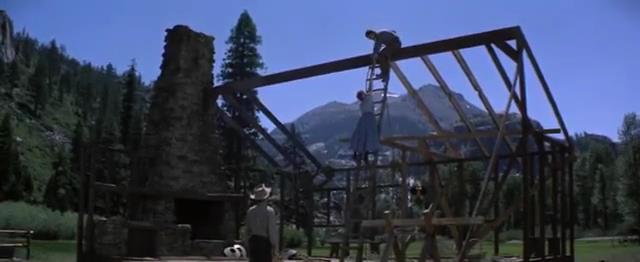
“Wagons,
Wheat Seed, Wheelbarrows, Whitewash,” Kennedy proposes the joke right out
of “a Monkey Ward order book... Satisfaction Guaranteed or Your Money Back”.
The
matter of taming the young proceeds from Flying
Leathernecks (dir. Nicholas Ray) and The
Hunters (dir. Dick Powell), the province of a good woman and so forth (cp. Holiday, dir. George Cukor).
Jack
Nicholson’s Goin’ South is naturally related,
another line of thought on criminals evading the altar is to be found in
Dieterle’s Fashions of 1934 and
Shavelson’s A
New Kind of Love (cf. Fritz Lang’s
You and Me), doubtless the sonnets of
Shakespeare figure in.
Town
of Congress, Montana, whence a rogue saying “you left your jackass in
Congress.”
Andrew Sarris (The American Cinema), “Mail Order Bride and The Rounders
were low-key folksy exercises on the sexual mores of the New West...”
Howard Thompson
of the New York Times, “almost
makes it.” Catholic News Service Media Review Office,
“uneven Western”. Hal Erickson (All Movie Guide), “an engaging and involving western drama.” Halliwell’s
Film Guide, “mild western comedy drama.”
The Rounders
Kennedy’s
masterpiece of the cowboy life is enough to win a bet anywhere, there’s
nothing to it but ridin’ and ropin’ and fendin’ off cowpokes
who don’t know nothin’ and accomodatin’ exotic dancers from
New York who ain’t used to Las Vegas ways, and the Sedona Rodeo.
The Money Trap
Hang a whore, lose the dividend (Albee’s Everything in the Garden).
Nemerov’s
“The Sparrow in the Zoo” is all but cited, ironically.
|
No bars are set too close, no mesh too fine To keep me from the eagle and the lion, Whom keepers feed that I may freely dine. This goes to show that if you have the wit To be small, common, cute, and live on shit, Though the cage fret kings, you may make free
with it. |
A terribly
precise masterpiece, unutterably so, its positions are as absolute as may be,
in the face of things all along the line.
Howard Thompson
of the New York Times had a field
day, chucking this out with John Ford’s 7 Women.
Variety
blamed a “cliché-plotted, tritely written script”, by Walter
Bernstein out of Lionel White.
Halliwell’s Film Guide reports it as “competent at the lowest
level.”
Return of the Seven
The seven return
because Chico and the other men of the village have been taken away to serve as
slave labor for the rebuilding of a ruined church. Chico was played by Horst
Buchholz in the original, his replacement here is perfectly capable, but the
MacGuffin is weakened thereby, not from the standpoint of the film itself but
of the first audiences, who missed the point somewhat.
Kennedy’s
approach is very similar to Leone’s, except that Leone will employ the
flashback technique to introduce new material bodily, and Kennedy does not.
This makes the central megillah partly expository by dialogue alone, and this
is a further difficulty.
The structure is
a remarkable mirror-reversal of Sturges’
The Magnificent Seven, and this is the most difficult thing of
all (it’s prepared by having Vin meet Chris at a bullfight under the
guise of claiming a bounty on him of 500—“Dollars?”, Chris
wants to know, “Pesos,” Vin answers him). After levying several men
from jail, anticipating Aldrich’s The Dirty Dozen, the seven ride to the site of the church and face the usurpers down.
These latter ride off, regroup, and return in attack.
The density of
the megillah makes it hard, even though it serves the role of developing the
perfectly satisfactory image of the ruined church before the final revelation.
It’s all stated in the dialogue, but is repeated here to clarify its
function. Lorca (Emilio Fernandez) is not a bandito but a protector of the
villagers, he and his men have chased away and fought marauders and renegades
over the years, he’s bitter that good men have
died for the ungrateful peones, who now, in his view, “have it
coming.” Moreover, his two sons died, he wants to rebuild the church as a
memorial to them, but Chris reveals that they had sought to kill Lorca and
hired Chris for the purpose, because their father “ran roughshod over
them”. Chris was allowed to go free, but the fate of the boys was to be
honored in this manner.
A secondary
deployment of dialogue material has one of the seven (Claude Akins) tell a tale
of marauding Comanches besieging him and his wife, one bullet left, the wife begs
him, he obliges. This purely spoken device serves to reinforce the delicate
matter of the church involved in such doings (the priest is helpless).
In one artful
shot, two of the seven ride away to outflank the
opposition, and young Manuel in the foreground steps back and knocks over a
crate which bursts open and reveals sticks of dynamite. In the climactic
battle, the villagers, who had previously explained to the vastly outnumbered
seven that they could not help because they were “cowards,” now
rise to the occasion on the walls of the ruined church and hurl dynamite down
on the enemy, who are destroyed.
Emilio Fernandez
is dubbed by an actor whose voice sounds familiar, but what you see is an
unexpected resemblance to Luther Adler. The very name Lorca evokes the
surprising paradoxes and twists of the film, none of which justify its shabby
reputation, on the contrary, though they do demonstrate how such a film slips
past those who ought to know better. You can’t ask a critic to figure
anything out, he either gets it or he doesn’t, he’s like the
professional girl whom Lenny Bruce asked to read an autobiographical
manuscript, and who replied in despair that she’d honestly prefer to
fornicate, because as Dorothy Parker once said, you can take a critic out but
you can’t put him in the picture.
Kennedy enlarges
the discourse with a varied dolly-out in three shots: a close-up of a flamenco
dancer in a shower of sparks revealed to be on a trestle stage with
firework-wheels for an outdoor fiesta, a distinctive camera-car rendition of
Chris riding down a narrow lane between houses as the seven join him one by one
on their way South, and a down-angle of the villagers among the comprehensive
ruins of the church (looking as if it may have lit a spark in Peckinpah’s
mind for The Wild Bunch, which significantly utilizes the theme of a
captured compadre).
Kennedy sagely
introduces a dissolve to the spire of the old church at the conclusion of one
discussion, directly preparing the conclusive image of the church
“rebuilt” a long way from T.S. Eliot, perhaps, but certainly
“militant”.
Welcome to Hard Times
A sermon on the
sack of Rome, a great one, “the spirit of life” is in a place or it
is not, “except the Lord keep the city, the watchman waketh but in
vain.”
This is specifically
addressed to those who repine or pine for vengeance,
and to such a degree as to leave no doubt.
The nemesis
Bosley Crowther of the New York Times considered trifling, “even
I, with a .22 rifle, could have got him,” the film too. Variety
excoriated “lack of depth and perception in script and direction.”
Time Out Film
Guide takes it for a preachment
against liberal sob sisters, i.e., weak democracy,
Halliwell’s Film Guide finds it “curiously likeable, almost
symbolic.”
The War Wagon
A pivotal masterpiece
with a decisive and direct influence on John Huston’s The Life &
Times of Judge Roy Bean (note the spittoons the sheriff’s lackey is
cleaning at the beginning) and George Roy Hill’s The Sting,
especially in some curious details such as Kirk Douglas’s card
manipulations, setting the stage for Hill’s revelation with this
sequence, Douglas dismounts in a narrow pass, uncoils a lasso, hurls it
off-camera to a high eminence, where it evidently lodges (this is where the
director cuts to the stunt man, usually), Kennedy tracks the camera on him
continuously as he strides to the rocky wall of the pass and climbs up using
the rope with ease (the camera tilting) to the top (Jackie Chan puts this to
good use in Armour of God). When Bruce Cabot tries out the war wagon’s
Gatling gun, he effectually demonstrates the transition from Aldrich’s Vera
Cruz to Peckinpah’s The Wild Bunch.
Ebert at the time
noted almost unconsciously the secret of great technique revealed, if
that’s the word, by Kennedy. There are a number of famous gags and jokes,
and some less familiar by reason of his prodigious sangfroid in the
telling of each as a rule, a flexible rule that avoids reaction shots as
superfluous but not entirely, having as its main guide a plucked-string sense
of dryness supporting a panache of staring outright
fantasticality. In other words, Kennedy achieves a rare break with even the
cresting wave of Keaton’s deadpan, by casting jokes like anchors into
hidden depths. He comes out even with this ploy, as striking and inevitable as
it is.
John Wayne is
making a nighttime raid on his own home, which has been taken over by Cabot.
Guards stand watch over the grounds, oblique light just illuminates one by
striking his crossed bandoliers, he’s a very formidable figure but
he’s subdued in an instant. This is the characteristic control of the
material exerted by Kennedy, who leaves nothing to chance when it comes to
evaporating hilarity. Now compare this to the Oriental Palace saloon, where
Douglas is ensconced with two girls who happily speak no English, in robust
frontier rooms, himself wearing a shirt of black leather and a canary kerchief
tied to one side around his neck. In one of the famous jokes, he opens a door
and finds Wayne, who is wearing long johns, shaving himself with his pistol
belt on. Douglas, wearing over his pants a short black silk Japanese robe
decorated with a golden dragon on the back, returns to his room and takes off
the robe, revealing his own pistol belt.
It’s not
far from this to Terence Young’s Red Sun. Kennedy’s way of
filming this owes its debt to Keaton (Douglas is first seen in the robe facing
the camera, he turns incidentally to give the screen that dragon) and yet is so
efficient as to do justice to its model by determinedly vaporizing the comedy.
This swiftness
gives results. A tense saloon scene anticipating the finale of The Sting
is interrupted by Howard Keel, who blusters in and demands a drink at the bar.
Indians are not served, he is told, and where Michael Winner begins Chato’s
Land with a gunfight, Kennedy dissolves the scene in a general brawl.
There is a close
thematic link with Howard Hawks in his later Westerns, and this too pays homage
in kind (the drunk, played by Robert Walker, Jr., is an explosives expert). The
conclusion is a similar understanding of The Treasure of the Sierra Madre,
and there again is a preparation of The Wild Bunch.
It’s pretty
clear now what Kennedy meant by The Good Guys and the Bad Guys. From
there, you move on to The Train Robbers, which is one great joke
transcending them all.
The classic
Western is consciously admired in The War Wagon. It’s a thing of
thundering hooves in tracking shots out in the middle of nowhere,
and also sometimes of horsemanship brought to virtuosity. Douglas lights from
his horse onto a tall rock easy as you please, he elegantly surpasses Roy
Rogers (another tribute) in a way by leaping into the saddle from behind and to
the left, quickly throwing a leg over. Between two horses, he places a hand on
each and bounces into place, all of which prepares the last shot, a lazy
man’s leap over two horses to a third right in front of the camera, which
never misses a thing. All of this is underdone so as to be almost unnoticeable,
by comparison for instance with Lancastrian bravura, a running joke exhibiting
the Kennedy finesse as well as the Douglas aplomb, and defining the tightlipped
comic stare of the film’s style throughout.
The title ballad,
which is sung by Ed Ames, has the composer and the lyricist of
Zinnemann’s High Noon back for an encore.
Support Your Local Sheriff!
The opening shot
is of a wagon driving headlong over the camera, with a quick cut to a team of
horses racing westward, held in medium close-up as a tracking shot. It depicts
a land rush as the sequence unfolds during the credits, and prefigures the end
of The Good Guys and the Bad Guys.
The film begins
on a fine down-angle of the swarming, brawling town, and a
good trick pans the camera right at street level slowly to the signboard
of Madame Orr’s House. This is essentially repeated as Jason McCullough
(James Garner) rides down Main Street with the camera tracking on his right,
and storefronts to his left (behind him), with one sign reading Constitution
Hall and the next The Original Dixie Restaurant.
A chorus of civic
leaders (Harry Morgan, Henry Jones, Walter Burke, Willis Bouchey) ponder the
town and its need for progress (again anticipating The Good Guys and the Bad
Guys), with an especial need for a sheriff.
What follows is
taken from Ford’s My Darling Clementine to establish McCullough as
the new sheriff. You can’t get a quiet meal in town, even at exorbitant
prices out of a slop-bucket, he’s on his way to Australia and needs
money, a hand-lettered advert says Apply at Perkins’ General Store.
The rest is a
wonderful parody of Hawks’ Rio Lobo, with Walter Brennan as the
villain, and Jack Elam opposite him in the role created by Brennan in To
Have and Have Not and Rio Bravo and then played by Elam in Rio
Lobo (and by Arthur Hunnicutt in El Dorado).
Kennedy’s
serene aplomb is in McCullough’s application scene. What are his
qualifications? He tosses a coin up in the air of the general store and draws
his pistol and fires, the coin comes down (after a cut) with Giotto’s O
in it. The mayor pastes a bit of paper over the hole, up the coin goes again,
and this time there is no cut before it comes down, shot through.
The advantage of
the construction is to give a sense of vocation, so that in its way Support
Your Local Sheriff! (the title figures as a banner
across Main Street by and by) is one of the great mysteries devoted to its
subject, like Montagne’s The Reluctant
Astronaut, behind its panoply of Ford and Hawks.
Young Billy Young
Hawks’ Rio Bravo is the object of this study,
with Dickinson in the same part, and Mitchum from El Dorado.
The main problem
of taxes unpaid (cf. Sherin’s Valdez Is Coming) extends further to a
case of homicide.
The action is
mainly in Lordsburg, setting out from Bisbee, with obtruded memories from Dodge
City.
These last
resemble Leone’s flashbacks, still more the Niven Busch Westerns, and
there is Mitchum (Walsh’s Pursued).
The stunning fact
is, Bosley Crowther speaks of “a hill of beans”, and Variety would have trimmed it as nothing
worth.
It opens
magnificently with an up-angle from a floating position in front of a Mexican
railroad train, craning to look past the chuffing smoke over the several cars
in motion, and this is the cue for young Billy Young’s exploit south of
the border.
Another
of the great ballad Westerns following on Zinnemann’s High Noon,
itself a memory of the cowboy singers (Mitchum crooning).
The Good Guys and the Bad Guys
Kennedy’s
excernment of a realpolitik in Western guise (cf. Gaudier Brzeska’s story about the little bird that fell out
of its nest in Russell’s Savage Messiah).
Nowadays when the
terminology has been revived, it’s instructive to consider this epic
investigation of the matter from the standpoint of a small but growing town at
the turn of the twentieth century, a variant of Hathaway’s finale to How
The West Was Won, with overall reference to High
Noon.
Dirty Dingus Magee
“None
but!”
The mayor is a
madam.
John Wesley
Hardin, the notorious outlaw, plays the harmonium at her wedding to the
sheriff.
Dingus the
“part-time assbreaker for the Overland” steals from Hoke and has to
raise the ante when the latter becomes sheriff.
The best
customers are the cavalry, off to Little Big Horny. The mayor needs an
uprising.
Dingus and Anna
Hot Water flee her people, bringing on the deluge.
“That
broken glass looks like Chinese jade of the Ming dynasty.”
Echoes of The Kissing Bandit (dir. Laslo Benedek).
“Hot
damn!”
The Deserter
Kennedy goes to
Italy and Spain for a Clair Huffaker Western about a captain who leaves the
damn U.S. Cavalry to hunt Apaches on his own and leads a raid on a war party
south of the border.
That’s just
about sufficient to tell the tale, Howard Thompson of
the New York Times woke up and wrote of “the steady, keen-edged
direction of Burt Kennedy.”
Halliwell’s
Film Guide could not follow this,
“muddled”, it says.
A distinct
impression is created in the final battle scene that a sincere homage to
Peckinpah’s The Wild Bunch is partly the point,
on the other hand, the Italian style is effectively seen in the sudden eruption
of an Apache sneak attack into a Battle of Cascina on the second.
The special
detachment that fords the Rio Grande is a ranger unit of the title
character’s own devising, made up of hand-picked
“volunteers”.
The Army cannot
fight the Apaches, John Huston as General Miles orders the raid to prevent the
destruction of the Southwest.
Support Your Local Gunfighter
The first article
of film criticism is that what cannot be understood at first glance by l’homme
moyen intellectuel must be vituperated. It’s sure to be found in the
guild rules, though one derives it from observation. In the case of Support
Your Local Gunfighter, the film begins by ignoring all the rules governing sequels, in fact it’s not a sequel at all. Then, with
some of the audience and most of the critics reeling, it becomes a developing
comedy of such complexity as to make Support Your Local Sheriff! appear simple by comparison. Add these two circumstances
together, and you get the Chicago Sun-Times review.
Kennedy is well
aware he’s on the home ground studied by the Italians,
it gives him leverage to poke fun. This derived position, cinematographically
speaking, is figured in the wooden Indian and Oriental Chop House sign of a
certain shot. Kurosawa’s Yojimbo was
looking in the same direction as Leone’s Per
un Pugno di Dollari.
That’s
where Kennedy’s looking as well. It’s about the nightmare of
history, and the Wild West as a fresh start. The town of Purgatory (a foretaste
of Hell in Eastwood’s High Plains Drifter some ways) offers this,
somewhere between its muddy torpor and its wildcat, Patience (Suzanne
Pleshette), who takes a potshot at a man for proposing to her.
Latigo (James
Garner) has a comfy but loud mistress (Marie Windsor), and her name tattooed
across his chest. He has his faith, an indomitable obsession with the number
23, sorely tried at the roulette wheel, and loses. He needs money, certain
townsmen (Harry Morgan, Walter Burke, Willis Bouchey)
need a gunman, and they think he’s Swifty Morgan.
The real Morgan
(Chuck Connors) shows up later, like Gogol’s Inspector General. In the
meantime, Latigo persuades shambling Jug (Jack Elam) to take the job, splitting
the proceeds. The problem is a mining tycoon (John Dehner) whose underground
demolitions shatter the town’s peace nightly.
There’s a
nice extension of the theme with Latigo first working a con on the owner (Joan
Blondell) of a saloon called Jenny’s Acme. The characteristic sign
language of Support Your Local Sheriff! is continued and further
developed, as when Latigo leaves the bar after losing all his money a second
time, and the two signs behind him (to his left) as he walks read “Open
All Night” and then “Shorty’s Wagon Yard”,
respectively.
Altogether, a
completely different film from Support Your Local Sheriff!, but with a certain number of
thematic links and undercurrents, and some returning cast members, all of it
pure Kennedy in its style almost to paroxysm. That, too, is part of the
structure, just at the moment when the whole thing becomes blindingly funny,
Doc Schultz (Dub Taylor) takes one more drink at the bar and topples right
over.
Hannie Caulder
She’s
burned out of home and hearth by thieving assholes.
A bounty hunter
takes her south of the border where a new weapon is forged (no-cock double
trigger).
She hunts the
assholes and kills all three one by one (whorehouse, perfume shop, old prison),
meets up with a gunslinger, they ride together.
The Train Robbers
Das Ewig-Weibliche zieht uns hinan.
The main idea comes from Laven’s Sam Whiskey
and is treated straightforwardly as a matter of course,
moreover Kennedy buttresses the structure on the implied suggestion of
Farrow’s Hondo.
Greenspun and Ebert were offended and perplexed by
the conclusion, which Siegel and Boetticher derived from Cook’s A Big
Hand for the Little Lady and worked out in Two Mules for Sister Sara.
Even so, a deeply mysterious film, a tale of idlers
on a do-gooding expedition (“something to do”) who forgo the reward
and find out they’ve been had.
All the Kind Strangers
Homage
to Walker Evans and James Agee.
A New York
photojournalist on his way to California gives a small boy a lift and becomes
Pa to a gaggle of orphans with a similar captive as Ma.
Several escape
attempts precede the calling of witnesses among the family.
Stacy Keach,
Samantha Eggar, John Savage leading the children, and Lebanon, Tennessee.
The Killer Inside Me
A psychological
foundation for the social wreck, essentially worked from Hitchcock’s Marnie. The scene is Central City,
Montana, a copper-mining town, for the flavor of a Western manqué.
The conservative
town boss and the liberal district attorney are running for mayor, the
boss’s son is an “ape”, a deputy
sheriff straddles the fence into dementia præcox.
The exceptional
screenplay is entirely structural, the dilemma is figured in the least of its
parts.
Critics do not
seem to have perceived anything of Kennedy’s film, a masterpiece if ever
there was one, if Time Out Film Guide
can be taken seriously with “hopelessly stodgy and psychologising”.
Very
deep casting, great score.
The questions are
raised toward the end, can the disease be worse than the cure, and is this not
a general decline as of age?
Kennedy makes a
great study of the town an essential part of the picture.
The Wild Wild West Revisited
The atom bomb and
a bionic couple are the first inventions, in 1885, created by the son of Dr.
Loveless, whom West refers to as “Junior”.
Junior’s
object is to rule the world, he has kidnapped Queen Victoria, King Alfonso,
Tsar Nicholas and President Cleveland for this purpose, doubles rule Britain,
Spain, Russia and the United States, furthermore bombs in every capital are
meant to force surrender.
A sort of
futuristic gizmo, the bomb, yellow with red appointments and silver fittings.
Female agents
from the foreign intelligence services take a hand, and so does the ambitious
nephew of the Secret Service chief.
Junior has
doubles of himself around the world, too, so the case is closed, hardly.
Such a debt to Casino
Royale (dirs. Huston et al.) is repaid by its really integral
analysis.
West is at home
when called, defending his wives from banditos
infesting Tecate, Gordon a strolling player with the Deadwood Shakespeareans on
the stage in Kansas City.
A young fellow
haunts West at every turn seeking a gunfight to avenge his father, killed in a
Secret Service raid.
Concrete Cowboys
Down from Montana
on their way to Hollywood they’re in Nashville preyed upon as private
eyes to solve the case of the wounded wannabe.
Prime humor at
the Opryland Hotel, behind the scenes at the Country Music Wax Museum, and
assembled with Roy Acuff, Ray Stevens and Barbara Mandrell in person.
It starts with a
crooked poker game Reed and Selleck pull down like Samson, then Sangster has
them hobo to anywhere in a boxcar.
More Wild Wild West
A superb portrait
of Dr. Henry Kissinger as Harrison’s Secretary of State Dr. Henry Messenger, mirrored in the madman Albert Paradine II.
West and Gordon
are suspended above tigers in a proto-Circus Circus, while invisible Paradine
seeks a world at odds and evens and Dr. Messenger goes down in history.
Wolf Lake
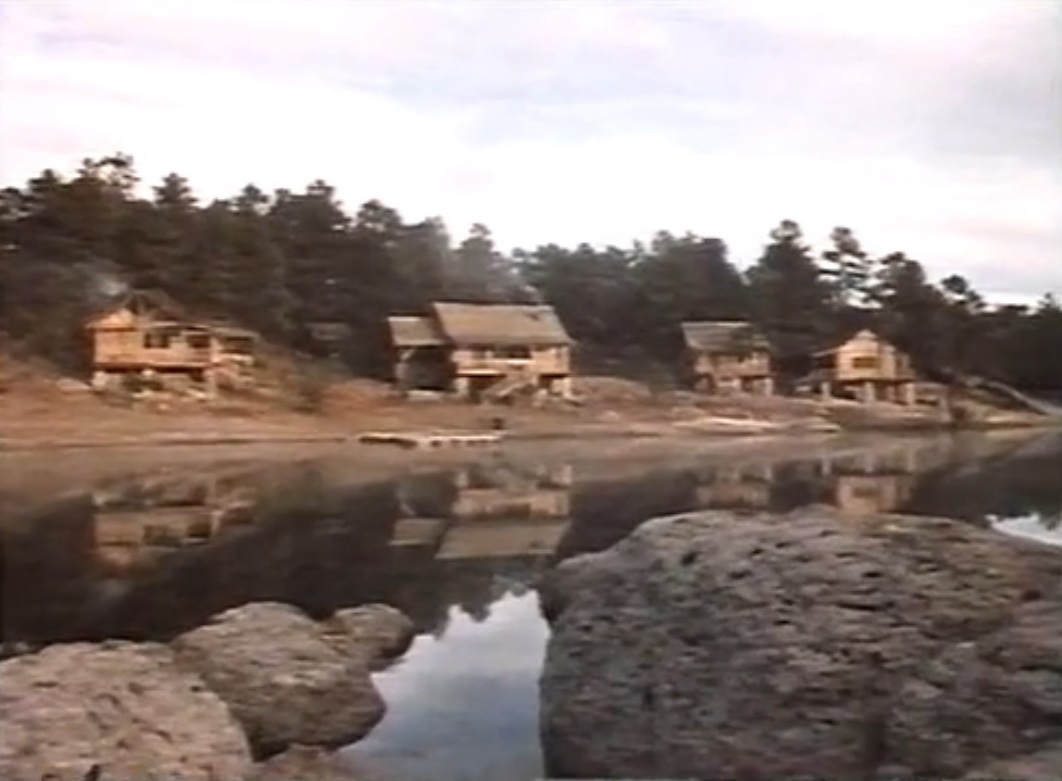
A
Canadian hunting party, “fall of 1976”. A deserter (vd. Kennedy’s
earlier film) from the 82nd Airborne, cf.
Polanski’s Death and the Maiden,
“take Nam. The killings. I didn’t stand by
and watch. I was part of it. I liked being part of it.”
Cf.
Kazan’s The Visitors,
“I’m not afraid of Charlie.” Something of a
masterpiece on the Second Hundred Years War dating back to the Hun.
Cf. in
various respects Collinson’s Open
Season, Peckinpah’s Straw Dogs.
Screenplay
by the director (with JFK in view), cinematography Alex Phillips, Jr., score
Ken Thorne.
Hal Erickson (All Movie Guide), “turkey”
(as The Honor Guard).
Betty Grable Flies Again
Simon & Simon
A B-25 pilot
learns that his old plane is running drugs. Kennedy’s dispassionate view
is partly conditioned by the final chase scene, which involves a private
helicopter attempting to down the Betty Grable. A gag from Stanley
Donen’s Arabesque concludes it.
The very funny
script has A.J. as a mock German asking Rick for a translation of “kitschig
auf Englisch.” The answer is “funky”.
Bubba the
battleaxe is offered a phony run south of the border. “Pass,” she
says, “I’m allergic to bananas.” The pilot,
“Irish” Dan Kelly, introduces the pair as “Simon &
Schuster, Private Eyes.”
Kennedy finds
time at Arch’s Hangar to establish a restaurant scene in fine CBS style.
A hood says, “you’re not going to shoot me here!” Rick asks
Arch if it’s all right with him. “Sure,” says Arch,
“just let me lock the doors.”
The Trouble With Spys
A lovely little
forerunner of Schepisi’s The Russia House, as charming as can be
and, owing to critical neglect, something of a secluded getaway.
A perfectly
brilliant film that apparently fell afoul of the distribution system or certain
aspects of the political arena at the time, but is not to be missed by admirers
of Burt Kennedy or the cinema in general.
“Let’s
do it undercover, let’s take our love on the lam.”
Effectively a
remake of Gilliat’s Left Right and
Centre.
Once Upon a Texas Train
A very
mysteriously fairy-tale construction upon a parable akin to Kafka (Aphorism
109) and Beckett (the mirlitonnade “à l’instant de
s’entendre dire”), summing up the entire expression of
Kennedy’s ideas with especial reference to The Good Guys and the Bad
Guys, The War Wagon and The Train Robbers, and modestly
couching this in a tribute to Edwin S. Porter.
Everyone knows
the latter half of Kafka’s aphorism, exacerbated by Beckett, the rest of
it posits life itself as a form of belief, inexhaustible and self-affirming.
Kennedy traces
the steps from Baudelaire (“L’Âme du Vin”), Cocteau
(“Les Voleurs d’enfants”), Renoir (Le Carrosse
d’or), his Christ among thieves wants no burnt offerings, his God is
no Texas lawman. His good guys and his bad guys are old, at the summit of human
experience, and impart to young outlaws the teaching of this film.
Structurally this
is a significant recomposition of The Good Guys and the Bad Guys,
maintaining the situation but reduced in scale to amplify the exploration of
the formula: old guys good and bad versus young bad guys. All the elements
receive and merit equal attention, which is not exhaustive by any means but
fugitive and quicksilver. Where Kennedy draws his lasting colors from is his
deep structural idea of how to make a movie.
He tries out his
moonlight effect by a campfire. It shines obliquely on the side of a horse
parallel to the camera. At night in the ghost town, this blue gel floodlamp strikes
the outdoor set largely, and he catches it right. Again, in concert with fires
and lamps, it sets up the moonlight disquisitions of the various parties before
the shootout at sunup. Kennedy takes his time with this, and there is a
revelation of the good guy/bad guy animus, but it’s moonlight writ large.
Crucial details
are handled to obtain precise effects. Richard Widmark as the Texas Ranger
captain is driven by jealousy over his wife. He pulls from his saddlebag her
picture, a sufficiently authentic presentation card with Angie
Dickinson’s daguerreotype, and looks at it lengthily. That’s enough
to depict the theme, but Kennedy dissolves to his memory of a ball and her
flirtation with the bad guy, Willie Nelson.
Superficial
impressions, precision treatment, hallmarks of his style. And through it all,
superb medium shots of desert scrubland, very surprising and natural—not
backgrounds but elements of composition, amid mountains serving that general
purpose.
Where all this
leads him is Dickinson emerging in a violet dress from a stagecoach with yellow
wheels, in that landscape (an effect from McLaglen’s The Ballad of
Josie).
The subtle
opening and close are also a signature in the general form of a variant, if you
like, of The Train Robbers.
Suburban Commando
It takes off from
Brooks’ Spaceballs territory and takes on the essential ball of
shit, New Hollywood.
“Pure
simian crystal… worth more than all the money in China.”
The funniest
thing that ever hit Tinseltown II.
A pure spoof of
everything the market holds dear.
The genius of a
film director such as Kennedy is exhibited here for the patrons to get their
money’s worth.
There is no
other. “Hey, this isn’t a cultural powwow here.”
The Good Guys
and the Bad Guys, a great
illuminating satire, pales in comparison.
William
Blake’s flea descends from outer space as bounty hunters after Hulk Hogan
Space Warrior rusticated on Earth, so there.
It’s an
award-winning architectural firm. “Talk about cheap construction!”
One of the
greatest directors of his epoch in full flight, with ultimate reference to
Bergman’s Monostatos. Even Martinson’s Batman must take
precedence and no more over this masterpiece of cinematic art.
If it isn’t
Bergman’s The Seventh Seal with Shelley Duvall and Christopher
Lloyd as the suburbanites (and Larry Miller as their comical employer), you are
a monkey’s uncle.
All the genius
there is in the cinema, Kennedy expended upon it, but he had a lot of dullards
to send up, no end of them but this.
Joseph
Cates’ The Fat Spy is the only thing worth comparison.