Miss
London Ltd.
The girl who calls the trains at Waterloo (Southern Railway) and
the soldier who runs the Hotel Splendide meet under
the auspices of a venerable Anglo-American alliance, or how to get from
Bloomsbury to the West End by way of The Businessman’s Encyclopedia
in thirty-six volumes and The Works of Sir Walter Scott, with Arthur
Bowman (Bowden) as Arthur Askey.
Bees in Paradise
An island in the South Atlantic ruled by women, the sanctity of wedlock
is preserved by killing off the bridegroom once the honeymoon is over, lest he
stray.
Ferry pilots crash-land a bomber there and are up for grabs. Neither a
raffle nor the annual rugby match (Palace v Hives) can decide the matter to
everyone’s satisfaction.
“I think he’s cute, and his complexion would go so
well with my furniture.”
Love takes its course, Guest wrote the lyrics, the
pilot and the “pocket airman” find their mates for life.
Penny Princess
The absolutely true story of American and British involvement in
the liberation of Europe, like Laurel and Hardy in March of the Wooden Soldiers.
It is not an easy story to tell, there is so much of it, Guest
turns it into a prototypical British comedy the likes of which are very rare
and mostly Ealing or Delbert Mann’s inestimable Lover Come Back.
So recondite is the imagery, and so filtered as it were by
subsequent efforts, that it took John Sturges’ The Hallelujah Trail
to put the thing on an even keel once again, to say the least.
“A mighty transparent joke” was the idle boast of
A.W. in the New York Times, dismissing it out of hand.
The Runaway Bus
The little seeds of positive thinking come a cropper in the fog
at Heathrow, a BOAC coach drives passengers away to Blackbushe
bound for Shannon, but all is not well en route and winds up in the
“ghost village” of a Commando Training Centre with live ammunition
and a great pile of gold bullion in the boot, the takings of a well-planned
robbery.
The fog is so impenetrable that, in his New York Times
review, Bosley Crowther described none other than
Frankie Howerd as a “pseudo-comedian”,
and no less than Val Guest as a “misguided person”.
It is true, however, as Crowther very
nearly suggested, that Margaret Rutherford is excruciatingly funny.
Petula Clark, Toke Townley,
Belinda Lee and Reginald Beckwith, among others, went unnoticed.
Break in the Circle
The very thing asked for is Humphrey Bogart in Huston’s Key
Largo and Hawks’ The Big Sleep, as the basis for From
Russia with Love. Guest engineers this so very brilliantly that his Véry flares went off all through the Harry Palmer series
and into The Parallax View
(dir. Alan J. Pakula), with a significant afterimage in Ordeal by
Innocence (dir. Desmond Davis).
Or call it the midpoint between Fritz Lang’s Cloak and
Dagger on the one hand and Hitchcock’s Torn Curtain on the
other. Terence Young’s beautiful analysis accepts certain larger aspects
of the work as sketches for a general layout mobilized by action sequences.
Mike Hodges took another tack in Get Carter by emphasizing the tragic
discontinuity of the editing.
The Quatermass Xperiment
Darwin said he never had a day without pain since his voyage.
A solipsistic hallucination gives the strongest possible
structural formulation, but there is the fictional narrative as well as a whole
host of symbolic understandings based on the antipathy of Chief Inspector Lomax (“a simple Bible man”) and Professor
Quatermass, these include the space voyager’s right hand hidden like a
leper’s and forgotten like Jerusalem.
Whale’s
Frankenstein is the key film here and
in Quatermass 2. Jacques Tourneur’s Cat
People for the zoo, which leads directly and thematically to Ken
Russell’s Altered States.
The
Kneale theme is defined a hundred ways on its own
terms, the flower craving that turns to cactus, the raid on a chemist’s
shop, finally the giant blobby octopus on a scaffold for a BBC live
transmission called The Restoration of
Westminster Abbey (guide, Sir Lionel Dean).
Quatermass
perseveres.
Quatermass 2
Frankenstein again, also
Strock’s Gog.
Winnerton Flats, or
perhaps rather the recent dwellings adjacent to its former location, forms the
basis of Truffaut’s Fahrenheit 451
and Lumet’s The Offence, in a
certain way.
Siegel’s The
Invasion of the Body Snatchers is strongly indicated.
The “multiple organism” utilizes Her Majesty’s
Government to construct Professor Quatermass’s
rejected moon base here on Earth, for its own purposes.
The clarity of Guest’s film version is its main,
irresistible force when compared with Cartier’s brilliant live production
for the BBC.
The Abominable Snowman
The mystery it incarnates is naturally showmanship and an
adverse feel, the elements of Kneale’s
script seem to come from Capra’s Lost Horizon and pay compliments
to Arnold’s Creature from the Black Lagoon.
Humphrey Searle’s score adds gongs for the Himalayan
vastness, Cooper & Schoedsack’s King
Kong is another theme present in the soft understatement.
The lamasery has a visiting botanist (Peter Cushing) who joins a
scientific expedition seeking the yeti. One of the party is a professional
hunter (Robert Brown), the leader is a promoter
(Forrest Tucker).
Very adroitly filmed in an English studio and the Pyrenees.
Up the Creek
Rockets put the Royal Navy in mothballs, a great boon to Meadows
End.
Cp. The Baby and the
Battleship (dir. Jay Lewis) or Girls at Sea (dir. Gilbert Gunn).
Further Up The Creek
A perfectly astounding masterpiece, the necessary sequel on the
sale of HMS Aristotle and eleven other frigates to Algerocco.
The new Royal Navy is nuclear, of course, and has no use for them, bosun and crew take paying
passengers, quell a revolution, carry out a half-baked commando operation for
oil and discover the identity of El Diablo, the rebel leader.
Such is foreign ownership, retrenchment and the like.
Frankie Howerd, David Tomlinson again,
the crew, and Shirley Eaton, Thora Hird, Amy Dalby and so on at
thirty quid the voyage plus incidentals.
Yesterday’s Enemy
The crux of the matter lies in the MacGuffin, a captured
Japanese military map that shows a double flanking movement against the British
through two areas of impassable jungle, an unimaginable proposition on either
hand.
But since the anonymous New York Times reviewer evidently
missed the first half of the film and had no idea what it was about
(“nothing new... sermon on bravery... philosophical”), it must be
pointed out that in order to obtain intelligence of this map, a British captain
commits a war crime. The remainder of the unit is wiped out, an entire brigade
on the Burma retreat, and Guest’s film is the only thing gained.
“This is not a big or even important picture,” the
tardy Times reviewer concluded.
Expresso Bongo
A teenager in the show business, or the flyer and the spy.
A Kid for Two Farthings (dir. Carol
Reed),
and from the same author.
The nudes at the Intime Theatre,
pronounced “in time”, have not quite the custom they deserve for
their historical revue (Mary, Queen of Scots and Julius Caesar), the kids like
sucking Cokes and coffee in a jive dive, there’s a fortune to be made on
one volunteer.
Lattuada & Fellini’s Luci
del Varietà, Yates’ Summer Holiday,
and Lester’s A Hard Day’s Night have a piece of the action,
a regular star-is-born-in-Soho type of thing, done to a turn.
Not thought much of by Crowther and
Halliwell for some reason, though Time Out Film Guide says it’s
“probably Britain’s most abrasive and entertaining film
musical.”
Hell Is a City
Starling returns to Manchester after a fatal prison breakout, Martineau sent him away, the detective’s assignments
turn to murder and mayhem, the lid is off the reasonable city, it becomes
alluring to a policeman with a lonely wife, even.
Title from Shelley, “much like London...”
Variety admired it, Howard Thompson of the New York Times
considered it routine and British.
The Day the Earth Caught Fire
The theme is the Axis, on two fronts.
One of the great films, also as a study of tempo rivaled by such
things as Stevens’ Swing Time. The first twenty-five minutes are a great newspaper film, then in five more comes the shift to London in heat mist and
Whelan’s The Divorce of Lady X,
cyclone and drought, always continuous.
The divorce motif is labeled “IMPACT!”,
courtesy of Arthur Lubin.
Jigsaw

The critical
position in a nutshell, Brighton, Saltdean, the
question is put, “what about me, don’t I exist?” It is
burked, cruelly disfigured, “severed”, locked away one step ahead
of the scholar-gipsy and abandoned, no trace of handwriting remains.
Jack Warner plays Detective Inspector Fellows under the sign of
Sydney Greenstreet (cf. Siegel’s The
Verdict) for a certain prodigiousness there
amounting almost to monstrosity, which is simply the man’s genius, this
is the school for critics. All of the facts must be
assembled and the right track found, a great intensive labor at some length,
with false turns and dead ends, leading to an answer plucked as it were out of
the air.
The ratiocination of critical understanding made manifest as a
seaside murder mystery, the scene at the grocer’s is a masterpiece in its
own right.
Halliwell’s
Film Guide, “excellent unassuming entertainment.”
Easter Monday falls on Shakespeare’s birthday, the point
in question.
Assignment K
Wedding bells are
breaking up that old gang of mine, an intelligence network. This leads to a
surprising syllogism.
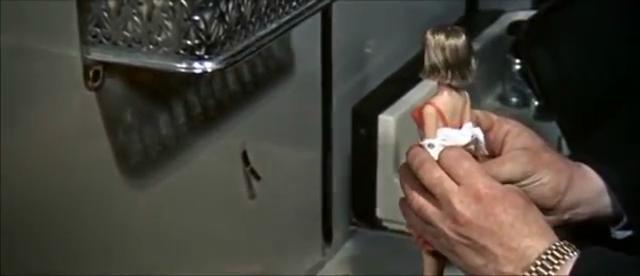
The game is pin
the microfilm on the dolly, the stiff one of Wellman’s Thunder Birds is part of the picture.
The theme is
closely related to Michael Anderson’s The
Quiller Memorandum, Sidney J. Furie’s The Ipcress File and The
Naked Runner, and Seth Holt’s Danger
Route.
A very nervous
theorem speculatively regarded and meticulously examined to a calm serene
finish not unlike the conclusion reached by Thornton Wilder on writers and
readers in The Bridge of San Luis Rey (dir. Rowland V. Lee).
A total blank
with Vincent Canby of the New York Times,
“earnest and totally confusing little spy melodrama”. TV Guide,
“uninspired espionage picture... overlong and boring... padded...
seemingly endless”. Britmovie, “uninspired and over-long’. Catholic News Service Media Review Office, “weak spy melodrama is cluttered with plot
complications whose only purpose is to afford changes of glamorous locales and
chic costumes.” Dan Pavlides (All Movie Guide), “lugubrious...
low-key... no key to unlock anyone’s imagination... nothing inspiring”. Halliwell’s
Film Guide, “dreary... instantly forgettable.. only
watchable at odd moments”.
When Dinosaurs Ruled the Earth
In prehistoric
times, a virgin escapes the solar sacrifice to join a tribe of fisherfolk.
Her lover escapes
the lunar sacrifice.
The primitive
critical response was summed up by Roger Greenspun in
the New York Times. “This requires comment, consideration, praise,
perhaps a poem. But not, I think, movie criticism as we commonly practice
it.”
Au Pair Girls
Girls just in
from the country, any country, without a thought in their heads but to watch colour television or meet Ricky Strange or help the scion
past his childhood games, perfectly done.