Mystery Sea Raider
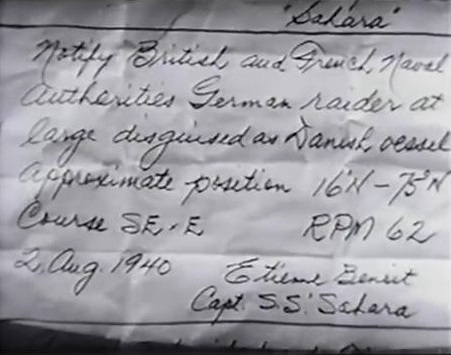
Enigma of the
S.S. Apache, hired off “the
mudflats of the Hudson” in hard times by the Nazis of Greater Germany for
service in the Caribbean as a prison ship and pirate vessel under the Danish
flag, skipper and crew sequestered below.
Cp. Seas Beneath (dir. John Ford) and They Dare Not Love (dir. James Whale),
later there is Mystery Submarine
(dir. Douglas Sirk).
TV Guide,
“standard melodrama-intrigue film”.
The Devil Commands
Discovery of
brainwaves and the electroencephalogram “as if a magic lantern threw the
nerves in patterns on a screen.” Following on this, “controlled and
scientific communication between the living and the so-called dead,” the
comparison is to radio, the spirit medium whose brain is eléctrico might serve as an
aerial.
“If you can
do what you’re trying to do, you’ll own the world.”
Thus speaks the
fraud, whose victim is a dull-witted laboratory assistant anxious to hear from
his late mother on a weekly basis, puppet-apparition and all. Medium and dupe
together just educe the dead wife’s brainwave, too much for the clod, his
canny exploiter persuades the scientist mad with grief to pursue his researches
on the lam, as it were, at a house above the New England seacoast.
Filmed
after the fall of France, released early in 1941. Don Siegel takes up the motif after the war in Night Unto Night.
T.M.P. of the New York Times found nothing in these
poetic themes from Robert Browning and T.S. Eliot, “a hodgepodge of
scientific claptrap,” too much for the clod. Same with Tom Milne (Time Out), “Dmytryk injects what
style he can”. Leonard Maltin,
“improbable but intriguing... predictable... absurd”.
The daughter narrates.
“My father never hurt a living person in Barsham
Harbor. Never.”
The sheriff takes a professional interest, “ordinarily I don’t pay
much attention to what people say, I
figure they’ve got to talk about something,”
cp. Doctor Blood’s Coffin (dir.
Sidney J. Furie) or The Plague of the
Zombies (dir. John Gilling).
“My father
had become a very strange man.” De Chirico masks for the grand séance,
Lang’s Metropolis, the vortex
of Quatermass and the Pit (dir. Roy
Ward Baker), a mechanical voice calls the scientist’s name, death of the
spirit medium, reconcilement with the daughter.
Milne praises
Karloff as “reliable” and arrogates this to Hitchcock’s Rebecca. No mention of Anne Revere and
the rest of the cast.
Down at the
little post office, a vengeful mob sets out, led by the late
housekeeper’s husband.
The daughter in
the mask, séance da capo, this time clear as a bell, the
voice, destruction and death...
Hal
Erickson (Rovi), “cheap but lively”. TV Guide,
“not entirely successful.” Halliwell’s
Film Guide, “modestly effective”.
Confessions of Boston
Blackie
The faux
Augustus, plaster saint, bears within the murderer first, and then his victim,
who is the fabricator of the lie.
Thus
Dmytryk in 1941, a simple case of art forgery. “Well, it was so beautiful I can’t
tell it from the original, so I feel that I saved the ten thousand.”
Leonard
Maltin, “delightful”. Hal Erickson (Rovi),
“superior series entry.”
Without a doubt,
“the only emperor is the emperor of ice-cream.” Blackie,
who incredibly misses hitting the assassin “by that much”, is
charged with murder even in the absence of a corpus delicti, so to speak.
A thing of
beauty...
Mona’s
badger game in Blackie’s apartment follows Mr. Kane’s Rosebud rage
by a factor of May-December.
|
BOSTON BLACKIE BAFFLES POLICE! |
Back
at the hideout, De Chirico.
“You’ve got a little Gestapo in you.”
“That’s why you’re not on the
pistol team.”
“A
million dollars’ worth of brains on a dead end street.”
“You’ve
got more signals here than a World Series pitcher.”
Hitler’s Children
“For
Hitler we will live,” they sing, “and for Hitler we will
die,” the Hitlerjugend.
“The sun that
shines for us is Adolf Hitler,” says the swearer-in.
German boys repeat this rubbish.
“My
Savior! My
Führer!”
Side by side in
Berlin, 1933, the American Colony School and the Horst Wessel Schule (Bonita Granville and Tim Holt are students in the
one and the other respectively).
“You
shouldn’t be seen over here, what would Dr. Schmidt say, and dear Mr. Schicklgruber?”
A
nimble account of “A Dissertation upon Roast Pig”.
Goethe,
“and those who live for their faith shall behold it living.”
The Jungvolk, bound and gagged for it. From here it’s straight on
for Rod Serling’s The Twilight Zone.
“You are barbarians, aren’t you, even
the Rhodes Scholars among you.”
Bosley Crowther of the New
York Times,
“muffs completely a fine opportunity”.
Variety,
“forcefully brought to the screen”.
The
Catholic News Service Media Review Office, “simple but effective”.
Leonard
Maltin, “engrossing exploitation film... quite sensational”.
TV Guide,
“far from an evenhanded depiction”.
Halliwell’s Film Guide, “artificial melodrama”, citing Howard
Barnes of the New York Herald Tribune,
“a curiously compromised production”.
The ending is a fine homage to Curtiz’ Casablanca.
Captive Wild Woman
Monkey nuts in
reverse turn a gorilla into a beautiful girl with charms to soothe the savage
breast, a great boon to an animal trainer filling in for Clyde Beatty at John
Whipple’s Circus.
An innocent girl
must be drained for this, and a smart dame gives up her brain.
Beatty himself is
seen in the cage, wielding a chair and whip and revolver.
By mistake, the
ape is killed after saving the trainer’s life. A similar erroneous notion
led T.M.P. of the New York Times to pronounce the film “in
decidedly bad taste.”
Jonathan
Rosenbaum’s Chicago Reader blurb inaccurately describes the plot.
Behind the Rising Sun
The true
nuttiness of Japan’s dream of world conquest is quite vividly seen (cf.
Santell’s Jack London), Dmytryk takes some considerable time with
it, to let the horrors bathe his film fully and then, only then, the true
position, and by then of course it is too late for Japan.
In
the middle of the war, the war in Tokyo.
A
great masterpiece not quite seen as such by T.S. of the New York Times
(“an honest and effective film”).
“A
good drama of inside info” (Variety).
Halliwell’s
Film Guide has “outrageous
wartime flagwaver”.
Tender Comrade
Dalton
Trumbo’s tale of the home front girls who worked in the war plants. Almost unbearably affecting and insanely maligned.
Trumbo represents
himself as Jones (Robert Ryan), who wants to take his wife (Ginger Rogers) back
to Shale City, Colorado after the war.
The girls share a
house for economy’s sake a short walk from USC, where Trumbo attended
classes.
Murder, My Sweet
Dmytryk, between Huston and Hawks.
The
irresistible rise of a showgirl from Florian’s on Central Avenue to a
vast manse in Brentwood.
She’s
blackmailed by a fashionable quack on Sunset, who dies.
Other
people die to make her comfortable.
Marlowe
gets sucked in on the original missing-persons call.
Philip
Marlowe, perched just above the city.
Hitchcock
takes note of the hypo-induced dream sequence.
Welles
has been cited as an influence (Citizen
Kane).
Back to Bataan
Its
clear, plain sailing of form consists in historical fact. The
fall of the Philippines, guerilla fighting under the Japanese occupation, the
return at Leyte.
But
purely formal difficulties are present, as the reviews attest, in the
construction of the film as very small scenes fitted together in fragments to
give a prismatic feeling of the events and permit tremendous scope and range in
what has been taken for a modest battle pic since the day Bosley Crowther first
saw it and titled his review, “More heroics”.
The
death march is just stumbled on when the guerilla party miss the significance
of the school principal’s execution. The schoolteacher’s imperious
command of history gives way before a student’s object lesson.
Back
to Bataan was up to the minute and
far ahead of its time. The difficulty of rendering Axis warmakers had been
addressed face-on by Riefenstahl, the charge of racism is absurd, Dmytryk has the best actors in Hollywood for his Japs. On
the other hand, his patriotism is that of Cummings’ Olaf, who “will
not kiss your f.ing flag”.
Cornered
It
begins in London, moves to the coast of France, then Marseilles, Berne and
Buenos Aires (Hotel Regent, Bar Fortuna). None of these places is very real,
tantalizingly so. An Argentinean subway car marked Florida comes into view,
briefly, and a night exterior of shops along a street is an approximation.
Composition doesn’t govern the shots (and in this it curiously
anticipates Pollack’s Jeremiah Johnson),
it can’t be called a film noir even though it directly figures in
Reed’s The Third Man and Maté’s D.O.A. quite visibly.
The
RCAF demobs a pilot (Dick Powell) shot down and imprisoned, his French wife of
twenty days was killed, he pursues the Vichy official (Luther Adler) who
betrayed her and who is thought to have died, or rather he intends to go to
France and settle her estate but the chains of bureaucracy and misinformation
block his way so terribly that he must give no quarter to any thought of
accommodation, his persistence and determination shake off every dead end, he
meets the man in Buenos Aires.
Composition
doesn’t even enter into the plot, the circumstances or the action. There
is no well-placed detective story with a hero bobbing and weaving, only the
simulacrum of a Fascist group not very far from Hitchcock’s Notorious,
and a man who has a pistol and a scar, his bitterness and smoldering impatience
are all the surface there is, not even Nina Vale’s enticing skintight
black lace is anything more than one element of a turgid nightmare.
“Unreal
cities”, and yet the state of mind is pierced by the hot charred remains
of a house set afire in the act of burning some documents that must be sought
out amidst the blackened beams and ashes.
A
Maquis leader, a Swiss insurance company, Walter Slezak as a nefarious tour
guide, some Argentinean anti-Fascists, and the Buenos Aires police, also people
the landscape.
Till the End of Time

The
unattainable achievement at the outset is the whistling down of a Marine
corporal at the end of the war to his home in “the growing city of the
world”, Los Angeles, with the greatest art Dmytryk attains it precisely.
“Well, Cliff, you’re—you’re back! You’re back
from the thing!” Which perhaps is where Christian Nyby gets his title. It takes Bergman all of Wild Strawberries to achieve the same
result, and then it is only a dream, a sufficient dream to balance the initial
nightmare.
It’s
the song, of course, from Chopin’s A-flat Polonaise. It’s in the
jukebox and on the radio, Leigh Harline orchestrates
it (also “There’s No Place Like
Home”), the complete works, like Dmytryk’s film. The shakes, “let them look.”
“And
if they don’t like it, let them kill themselves.” The dream that
ends in nightmare back home, cf.
Dieterle’s I’ll Be Seeing You.
The sheer waste of time, if nothing else, spent going to war, from a civilian
viewpoint.
FDR’s troops. “If Gunny can show me a book that’ll
teach a guy how to win a boxing championship with no legs, I’ll read
it,” cf. Zinnemann’s The Men. “Live on the beach and
swim, and lie on the sand in front of a fire, yes sir, that’s what
I’m going to do.” To put it another way, “where do I fit
in?”
“You’re
the velvet.”
Leonard
Maltin, “solid, sympathetic”. TV Guide, “had enough stuff to make
it ring the cash registers.”
An
extraordinary recapitulation of l’entre-deux-guerres and the war lately ended
concludes the film. “If worse comes to worse we’ll raise women,
too,” the Swan Club on Western.
Halliwell’s
Film Guide,
“downbeat”.
So Well Remembered
There
was a Kaiser, he had a daughter, that is the cultivated image principally, by
an extension of surreal processes they are mill owners in Lancashire, lording
it over a slum-ridden town up to 1945, with a twenty-year interregnum that
corresponds to the elder Channing’s prison sentence.
Their
opponent is a town councillor, alderman and then mayor, who also runs the Browdley and District Guardian.
These
are the metaphors, this is the construction. The film is a flashback from the first
intuitive victory celebrations in the town to the beginning of the story in
1919.
Crossfire
Who
killed the Jews of Europe? It’s a burning question, in 1946. The G.I. Joe
who moved too slow, the fellow who went off on a drunk with a B-girl?
The
Jew-hater, that’s who, then he kills a witness.
A
very complicated position is expressed in a very complicated film, andante
furioso, generally likened by critics to Gentleman’s Agreement (dir. Elia Kazan), which really is
about anti-Semitism.
Obsession
FDR’s
statue in Grosvenor Square decides the issue, framed by two club conversations
on England’s woes and America’s ascendancy, which are the basis of
the argument.
With Clouzot’s Quai des Orfèvres, an
important source for Columbo.
A deep, yet serene, and very brilliant masterpiece
on a theme that carries over into the critical perception, a case of jealousy
that prompts a perfect murder, ideal even.
Nino
Rota’s score is one of the best, Variety reports that the play
folded quickly, it makes a witty, lively screenplay that Dmytryk films with the
greatest attention and ease, conscious at every moment of the lightness in his
madman and the seriousness outside his purview, which does not include the
silly gorgeous wife and her latest, a Yank.
Give Us This Day
Snow and the building racket and the Great
Depression.
Dmytryk
ahead of Rocco e i
suoi fratelli (dir.
Luchino Visconti) and Le mani sulla città (dir. Francesco
Rosi), on New York, filmed in UK during one of America’s “periods of historic madness.”
A great likeness of Gian
Maria Volonté in the role, Sam Wanamaker.
Cp.
The Stars Look Down,
dir. Carol Reed. Perhaps the most arcane influence is on Once Upon a Time in America, dir. Sergio
Leone.
Bosley
Crowther of the New
York Times, “standard hard-luck story, rather heavily composed of
stock woes.” Variety, “the expert hand of Edward
Dmytryk’s direction ensures faithful atmosphere.” Jonathan Rosenbaum, “in some respects
this is Edward Dmytryk’s best film.” Hal Erickson (Rovi), “terminal sanctimony.” Halliwell’s Film Guide,
“a very curious enterprise for a British studio,” citing Winnington and Mallett of two
minds.
Mutiny
The
domineering mistress, wholly unscrupulous and perfectly hypocritical, fetched
back from Paris on the promise of an old lover’s advancement, is an
adequate image of impressment in 1812, add to that a ship’s anchor of
solid gold for the United States raised by private French subscription, so
disguised to run the British blockade, and you have the temptation.
Crowther
thought it was a joke and himself “the outside
observer who, despite Technicolor, is unimpressed,” which he probably
meant as another.
The Sniper
A
man wronged by some woman in his past (so goes the theory) takes vengeance on
the likes of her with a carbine.
Much
later there is Dmytryk’s Bluebeard, The Sniper makes a case
for psychiatric care early on in such instances, and sure enough there is
Siegel’s Dirty Harry to deal with the same mess in the same
locale, as predicted.
Crowther
(New York Times) thought this was footling and “a dignified
excuse”, he looked for “the menace and the understanding of the sex
fiend”.
Halliwell
thought it was blondes, not brunettes, and says it “seems quite routine now.”
Lt. Frank Kafka and Sgt. Joe Ferris have the case.
This
is very touchingly constructed, the aged landlady pampers Asa, her cat, but
expects him to do his job like everyone else, catching
mice in the basement (Asa watches wide-eyed as the sniper burns evidence in the
furnace). The lady supervisor at the job is perfectly hard and belittling, women generally are seen as easily cruel and
heartless, if they’re not laughing and in love, even a mother with her
son. This of course is the sniper’s view, he burns his right hand on a
hot plate to circumvent the temptation, providing the image that is perhaps the
most telling (unless it is the painter shot on the side of a factory stack as a
witness, or the sniper caressing his carbine), “let my right hand forget
her cunning.”
The
murders are quite matter-of-fact, death from a distance, shattering glass and
dropping the girl at once.
Fleischer
in The Boston Strangler has again the roundup of perverts that is a dead
end, the police psychiatrist puts the detectives on a
more direct trail that leads to the sniper seated on his bed, carbine in his
hands, a tear on his cheek rather than some “less sad secretion”
otherwhere.
Eight Iron Men
How to get a medal in the war. It takes some doing, after some talk and red tape,
lobbing ‘em in, pulling back and so forth, you put a pineapple in the slit
and bring the slob home.
It
was a play at some point, Dmytryk doesn’t say how.
“A
dismally meretricious thing,” said Bosley Crowther.
The Juggler
Carpenters,
plumbers, they have jobs in Israel.
He
all but kills a Haifa policeman, psychotic since the Nazis, at times.
Formerly a star at the London Palladium and
elsewhere, a refugee.
The
theme of artistic invincibility is also in Russell’s Dance of the Seven Veils.
The
back page of the newspaper stays burnt despite the abracadabra, at the same
time on a kibbutz the cows come home.
“If
all the old men could hire young men to die for them, a young man could make a
very nice living.” Also, “hope is a naughty word these days.”
Kirk
Douglas juggles and clowns, his entrance pratfall is Lon Chaney’s in Laugh, Clown, Laugh (dir. Herbert
Brenon), among other things.
In
the end, one is at home, despite all appearances to the contrary.
Bosley
Crowther asked, “what’s
such a handsome girl doing unmarried on a community farm?” He could
supply no answer, the film “may not be
consistent dramatically.”
Filmed on location in town and country (Nazareth,
Galilee). The basis of the
screenplay is Capra’s Meet John Doe
as much as anything else.
“Well-meaning”,
Halliwell’s Film Guide thinks.
The Caine Mutiny
To put your oar
in is the main subject as it pertains to a naval captain’s reliance on
his officers, without which he becomes isolated and ineffective.
Despite the
clarity of Dmytryk’s telling, the film is variously misunderstood as
structurally inept (New York Times) or thematically jejune (Time Out
Film Guide).
Broken Lance
Variety lamented an “unnecessary flashback”. A
man serves his three-year term in state prison out West, leaves bitterly and is
escorted to the governor, who with the man’s brothers has a lucrative deal
for him to leave the state. The man tosses the money in a spittoon and rides
home to see the place a dusty ruin. Here the flashback commences.
A requiem for the
West or a long overture to a little theme announced earlier. The New York
Times’ A.W. agreed with Variety and furthermore considered
that “Jean Peters, as the Governor’s daughter, is decorative but
hardly the frontier type.”
The major structural point to be observed is a relationship to The
Caine Mutiny.
The End of the Affair
Obsession (The Hidden
Room), this time under the auspices of Graham Greene. The doodlebug is God’s thunderbolt (cf. Eliot’s “flame of
incandescent terror”), a private dick is put on
the dame after the war, one Savage at 159 Vigo Street.
The civil servant’s wife, an English wife.
The end of the affair is Losey’s Secret Ceremony.
Bosley Crowther of the New York Times, “if you ask us... the story just is not
articulate.”
Boxoffice,
“reflects an intelligent grasp of the subject at hand.”
The Catholic News Service Media Review Office,
“uneven... only intermittently convincing... disappointingly
melodramatic.”
Leonard Maltin, “loses much in screen
version.”
Halliwell’s Film Guide, “glum sinning in Greeneland;
over-ambitious, miscast, and poor-looking.”
Lenore Coffee screenplay, Wilkie Cooper cinematography, Benjamin
Frankel score, Alan Hume cameraman.
There is subsequently Fellini’s Giulietta degli spiriti
(also Billy Wilder’s Love in the
Afternoon for the detective, a family man).
Pinter’s The Homecoming
(dir. Peter Hall) is another statement of the theme.
Soldier of Fortune
Stravinsky was
stopped on a border in World War I, he was carrying
maps of military installations.
Those were
Picasso’s portraits of him, drawings.
A sad little
story out of Hong Kong, but you have to climb
mountains to find it.
Mrs. America goes
to find her husband, a journalist. The British are no help, there’s an
American smuggler.
The far end of
the Pacific war comes down to this.
Bosley Crowther
was entirely mystified in the New York
Times.
The Left Hand of God
The priest who is
not a priest, his dice-throws save the people from a
Chinese warlord.
This fine anagram
went rather by the boards with Bosley Crowther, it simply didn’t add
up in his New York Times review, the plausibilities and the fictions
wouldn’t jibe.
The Mountain
The wreck of a
jetliner, attempt at rescue, a looting party, rescue of a survivor.
Supremely
well-filmed until Dmytryk lets it go just before the end, because he has the
bigger fish of a surprising confession to fry, and thus a saving work beyond
its supreme analysis.
An
agonizing climb up the south face of Mont Blanc, a true piece of
mountaineering.
Eastwood picks up
the filming in The Eiger Sanction,
Zinnemann the theme in Five Days One
Summer, but it is all one.
Bosley
Crowther of the New
York Times, “flimsy and hard to take... of little account.”
The Catholic News
Service Media Review Office, “unconvincing... makes no sense”.
Leonard
Maltin, “turgid”.
TV Guide,
“a mistake.”
Hal Erickson (Rovi), “compromised”.
Halliwell’s Film Guide, “an indeterminate production”.
Raintree County
If
the antebellum South is described as Gone with the Wind, the North is
evoked as a tree firmly planted. Or, as Prof. Stiles might say, “a very
vast idea of the South, more arduous than Jezebel, which might be said
to sweep like Sherman to the sea and there find Daphne quite
transformed.”
Somewhere
in the swamps round about Freehaven, Indiana (Prof. Stiles explains) a single
seed of the rain tree (indigenous to China) was planted at the time of Johnny
Appleseed, and whosoever finds the tree will be endowed with “the secret
of life.” His pupil John Shawnessy expands, “it opens all locks,
heals all wounds.”
Young
Shawnessy is an admirer of Byron. After winning a foot race, he is seen at a
picnic wearing a laurel wreath and playing a reed pipe. These early, youthful
scenes are often formed on Impressionist models, tempered by Eakins and Homer.
The
crux of Show Boat is introduced with dramatic fervor. “Lincoln has
Negro blood in him,” says Mrs. Shawnessy. Indianapolis is described as
“a Copperhead town.” The quest for the rain tree is delayed as
“much too perilous a business.” Shawnessy joins the war to retrieve
his wife and son. The Union must be preserved.
Some
controversy attaches to the screenplay, which is complained of as being not
like the novel. To this day, it is necessary to point out to some in the
audience that they’re watching a movie. In addition, and most
obnoxiously, one must be told about Montgomery Clift’s accident. One is,
to the contrary, amazed by Clift’s performance throughout, and no
impairment is noticeable. Finally, and with characteristic self-deprecation,
Elizabeth Taylor speaks disparagingly of her performance as “chewing the
scenery.” Lucky scenery, and perhaps a tinge of
complaint against Dmytryk for the intensity of the recital on the bed.
Clift’s attention paid is a model for Alan Bates’ (to Janet Suzman)
in A Day in the Death of Joe Egg (dir.
Peter Medak).
There
is an unmistakable influence on Lean’s Doctor Zhivago and elsewhere.
There is a report that top critics maligned the film as beyond contempt. It is
beyond criticism. The pan-and-scan version is as incommodious as that of Ryan’s
Daughter.
The Young Lions
The
German officer who is gradually and completely disillusioned by the war.
The
crooner who goes into Special Services and finally requests action in Normandy.
The intellectual
(he’s reading Ulysses) who marries and goes overseas in the draft.
The second kills
the first, both have in common an acquaintance so hep
she goes to serve in the Office of War Information.
The main
objection of critics was the characterization of the first, “not like the
book”.
Warlock
An ultrafine
essential Western on the outlaw and the gunfighter and the lawman, better still
the criminal and the private operator or contract employee and the servant of
the law.
If critics had
not blinked and yawned, they would not have been so amazed by Henry
Fonda’s performance in Leone’s Once Upon a Time in the West
(there is also Vincent McEveety’s Firecreek).
The beautifully
rigorous analysis was lost on them, however, with all its overtones. Directors
from Ford to Eastwood noted it, with its conscious debt to My Darling
Clementine.
Walk on the Wild Side
Dialogue
between artist and client in a New Orleans brothel.
“Did you
buy me that Brancusi?”
“Nobody
every heard of him. I asked the whole City Hall.”
“He’s
a sculptor, darling. Like Michelangelo, Maillol, Rodin, and me.”
“Last time
you told me you wrote poetry.”
“No, I just
echo it. I’m a sculptress, or rather I used to
be, before I fell down the well.”
Hosea and T.S.
Eliot are called into play before Dmytryk is finished with his map of the
affections, the lay of the land.
“It is
incredible that anything as foolish would be made in this day and age”
(Bosley Crowther, New York Times, same day he dismissed Leo
McCarey’s Satan Never Sleeps).
“A
somewhat watered-downing” (Variety).
Time Out Film
Guide follows Halliwell in
thinking Saul Bass has the best of it.
Gene Kelly’s
The Cheyenne Social Club and Louis Malle’s Pretty Baby take
note.
The Reluctant Saint
He rides into the
priesthood on Buridan’s ass like the Great Cham on Bishop Berkeley, Kershner depicts his travails in A Fine Madness, so to speak.
Joseph of Cupertino,
his life and works, an edifying tale of Christian moral doctrine.
Ashby appears to
draw from it in Being There, the
source and wellspring is assuredly Curtiz’ film on the founder of the
order, Francis of Assisi.
TV Guide
saw “the village idiot who becomes a saint... but the stereotyped
performances, unbelievable settings, and lifeless direction hurt whatever
promises are inherent in the material.”
Tracie Cooper (Rovi) has rather “mentally challenged.”
Score by Nino
Rota, cinematography by Pennington Richards.
The Carpetbaggers
The fabric of the
film is made of ceaseless activity on certain models that are conceivable as
symbols only, that is for ease of composition and
clarity, they are all transmuted in the course of it. There is the one sturdy absolute
revelation of “incurable insanity” (Pauline Kael calls this
“pop psychology”) on which the whole thing pivots, that is the
entire lesson of action motivated by fear.
Critics have
always held a different view. Crowther is notably in error regarding George
Peppard’s performance as “expressionless, murky and dull”.
The classic joke
is that the valet is in on the secret, then the wife.
Where Love Has Gone
A
surrealistic examination of the architect as entertainer of rich clients in a
parent firm, then as a partner in civic planning, finally with an understanding
of the mysteries.
The terrible
difficulty of this left Crowther fuming with rage.
Mirage
One
of the great hallucinations on the screen, like being knocked unconscious and remembering
yourself by fits and starts. The structure is most complicated. A witty,
pointed radio script, cinematically aligned to a film
noir style, the homage (scrupulous, unbending) to Hitchcock, all to house a
somewhat difficult utterance. The analogy of poetic construction is usefully
applied throughout in rhymes, internal rhymes, assonances, etc. David Stillwell
(Gregory Peck) meets a girl (Diane Baker) on the stairwell during a blackout,
but the sub-basements turn up missing.
It’s memory he’s wanting. In a bookstore window he’s struck by
two books, The Peace Scare and The Dark Side of the Mind. He buys
a copy of the latter, goes to see the author, a prominent psychiatrist, using a
footnote as a reference. “You were referred by a dead man,” says
the genius (Robert H. Harris). Amnesia doesn’t last two years, he
explains, two days maybe, and throws Stillwell out.
Our
man now follows on the heels of Mr. Arkadin by hiring a private detective
(Walter Matthau), whose first case this is, to trace
his own identity. As they descend a plaza escalator, the camera on the next one
descends with them. At Stillwell’s apartment, the refrigerator is full,
though it was empty before. The closet is empty. “Brownies” are
proffered in explanation.
They
go together to Stillwell’s office, which doesn’t exist, and pass in
the corridor the office of Charles S. Calvin, Attorney-at-Law, who fell to his
death during the blackout. They examine the stairwell.
A
brutal, bespectacled thug (George Kennedy) is after Stillwell, who emerges from
the ruckus with a key and a keychain bearing the image of the Western
Hemisphere and a motto, THE FUTURE IS HERE. This is the company motto of
Unidyne, Stillwell is a cost accountant. The trouble is, he says, “I
don’t know what a cost accountant does.” The desk security man
knows him, the man with the funny name, Joe Turtle,
it’s off to his apartment. Turtle’s dead, another thug (Jack
Weston) thrusts a bloody pistol into Stillwell’s hand. “Better take
this, you might need it.”
The
girl in the talkative stairwell is confronted with the deed, “a portrait
of the man you work for... you know the artist by his work.” She says
“there was nothing I could do to stop it.”
To
avoid the police, they duck into a neighbor’s apartment. No-one’s
at home except a little girl, who serves them imaginary coffee. “Where
did you learn to make such good coffee?”, they
ask. “Television,” she tells them. “It’s coffier
coffee,” they agree.
Dmytryk
is just getting warmed up with this dense situation, which is itself in
counterpoint to Stillwell’s reviving memory, introduced as unprepared
inserts or cutaways, the unprepared flashback.
He
tells the detective he works for the Garrison Company, but none exists. There
is a Garrison Laboratories in the Capra-sounding town of Brewster, California,
run by Charles Calvin’s peace foundation.
Josephson
(Kevin McCarthy) rears his head, a work chum, formerly head of the
physiochemistry department at Unidyne. And all the while Stillwell is
struggling to recover his past, the girl from the stairwell
(who evidently knows him somehow) claims his future. “Promise
you’ll love me, David, promise me.”
Two
hoods from “the Major” make a play, Stillwell grabs one, threatens
to kill him. “I’ll save you the trouble,” says the other,
pulling a silenced trigger.
Now
you have the idea, this is very close in style and substance to Seven Days
in May, North by Northwest, The Big Sleep, Charade, Three
Days of the Condor, etc. Dmytryk is now ready to begin in earnest.
Stillwell
pursues his investigation, but finds an old derelict blocking his progress up
the steps of a building. After hearing the old man’s harangue, Stillwell
retorts upon him, “I didn’t ask for your references, all I want is
for you to move.”
He
finds the detective murdered, and smashes up the room in his frustration like
Kane. The old man turns up spruce with a gun in his pocket. Stillwell makes his
escape by conversing with a dendrologist about the gingko amidst a juvenile
field trip to Central Park.
Josephson,
the office chum, accosts him there, what they want is on a piece of paper
Stillwell must have upon his person. “What if it’s not in my
pockets?”, asks Stillwell, not knowing what it
is. “You’re all alone, David,” Josephson says,
“there’s nowhere for you to go.” The old man appears, and one
of the thugs. The old man is run over, Stillwell escapes, amid returning
memories of a conversation with Calvin in the country somewhere out West, to
the psychiatrist’s office again, where he is told “a doctor
can’t afford to stop at a street accident anymore.”
This
is The 39 Steps, of course, and Spellbound, much changed. Now the
beans are spilled. Garrison Laboratories is a radiation lab, most of it
underground. “I’m a physiochemist,” Stillwell remembers, who
worked on level SUB 4, and before that at Unidyne. The psychiatrist describes
amnesia as “putting a bandage on a bruised toe,” and adds,
strangely, “these are strange times.”
Stillwell exits with a curse on his lips.
CHARLES
CALVIN IS BURIED, reads the front page headline. He
fell 27 floors from his New York office.
The
Major (Leif Erickson) is the head of Unidyne. Calvin’s peace foundation
was only a front to house top scientists working on ways to neutralize atomic
radiation for ostensibly peaceful uses. Stillwell found a formula, went to New
York, learned Calvin’s secret, set the paper on fire rather than see it
fall into the hands of the Major for military use. Calvin clutched at it, went
out the window by misadventure. A clean bomb would cut down the overhead in
human statistics, says the self-described “cost accountant”.
The
girl in the stairwell shoots the gun-wielding thug, Josephson grabs it.
Stillwell persuades him, against blandishments of security and wealth, to call
the cops.
“I
believed in Charles Calvin so much,” Stillwell avows, “I forgot he
was only a human being.” “Help me, David,” says the girl,
“please help me.” He replies, “We’ll help each other.
That’s really what it’s all about anyway.”
Or,
as Benjamin Franklin put it, “we must hang together, or hang separately,
surely.”
Alvarez Kelly
The
Irish señor is roped into the cattle raid on Grant so much admired by
Abe Lincoln.
There’s
a whole story here about the South after years of war, the kind of man Kelly
is, and the one good raid that feeds the Rebs for a time. All of it is very
mysterious and abstracted, as well it might be.
“Script
problems” are often cited in reviews of Alvarez Kelly, it’s
not so simple as that, when you look at it.
Anzio
A very grueling précis of the war “from China
to Italy”. The antagonists
are Field Marshal Kesselring and an Official War Correspondent named Ennis.
The
battle is understood in its effects as the long descriptive middle section, a
succession of images, and in its causes as an outer framing device of question
and answer, symmetrically.
The
inner structure sees the unopposed landing, the short ride to Rome, the
disaster of the Rangers ambushed, the construction of the Caesar Line with
minefields and heavy fortifications, the farmhouse of a forced laborer, and
snipers on the rise.
Recklessness
precedes the landing, timidity accounts for the failure,
the corruption of contact with the enemy is the essential reason for an almost
feminine submissiveness to Kesselring’s absent response.
Dmytryk’s
masterpiece was generally trounced in reviews. Vincent Canby (New York Times)
dismissed its “fatuousness”, Variety its
“banality.” Roger Ebert (Chicago Sun-Times) saw the film and
found it praiseworthy, Tom Milne (Time Out Film Guide) has
“run-of-the-mill”.
“Threadbare”
is Halliwell’s Film Guide’s assessment, giving the Monthly
Film Bulletin on “crassly portentous statements” as well.
Shalako
It’s
a rough rhyme for calico, has a meaning in Zuni Indian, and replaces Moses
Zebulon as a convenient moniker.
Renata
Adler of the New York Times found it an agreeable Western, but sitting
as she tells us in the front row of a crowded theater, fell under the
impression that Stephen Boyd was playing an Andy Devine character, as she puts
it.
Thus the critical spectrum.
Carl
Sandburg would have loved Alexander Knox’s story of Lincoln’s first
vice-president.
Honor
Blackman goes one better than Tallulah Bankhead in Lifeboat.
Peter
van Eyck has the difficult role of a man who is always wrong and rises above
it.
Brigitte
Bardot hides behind makeup as a lady of the time, and emerges from it in two
very pretty love scenes.
Sean
Connery is a great Western star in this, and no mistake.
European
aristocrats and an American senator out West for a spot of hunting
(Dmytryk’s unforgettable studies of a mountain lion) are bamboozled by
outlaws and beset by Apaches.
Dmytryk’s
performances are typically structural, thus a reviewer cites Bogart in The
Caine Mutiny as “tired and lacking charisma” without noticing
that’s the point, Captain Queeg is battle-weary and without charm. In Shalako,
the acting is top of the line and then some, Dmytryk’s art in this
respect can be admired somewhat more freely.
But
it failed at the box office, and he disavowed it precisely as Hitchcock would
have done.
“It’s
only humiliation,” as Judy Holliday said about auditions.
Bluebeard
The proto-Nazi
baron is a World War One ace shot down by the Russians. His impotence stems not
from the injury that scarred his face and altered his beard, but from a
crippling devotion to his late mother.
The vexatiousness
of women is exposed to a mortal degree in his various brides,
he has no answer but to kill them.
A
takeoff from Hitchcock’s Psycho.
Ebert bemoaned,
incredibly, “the sad disintegration of Richard
Burton’s acting career.”
The “Human” Factor
A
front of the Cold War, NATO Southern Europe, Naples.
Friedkin picks up
a major theme for The Guardian
(deadly hired help) and a major indication for Jade (the stalled car chase through Rome).
A.H.
Weiler of the New
York Times, “improbable and gory”.
The Catholic News
Service Media Review Office pronounces the work “morally
offensive”.
Time Out,
“this movie achieves a certain bulky conviction of its own.”
The score with
its homage to Maurice Jarre is one of Morricone’s most beautiful.