Dernier atout
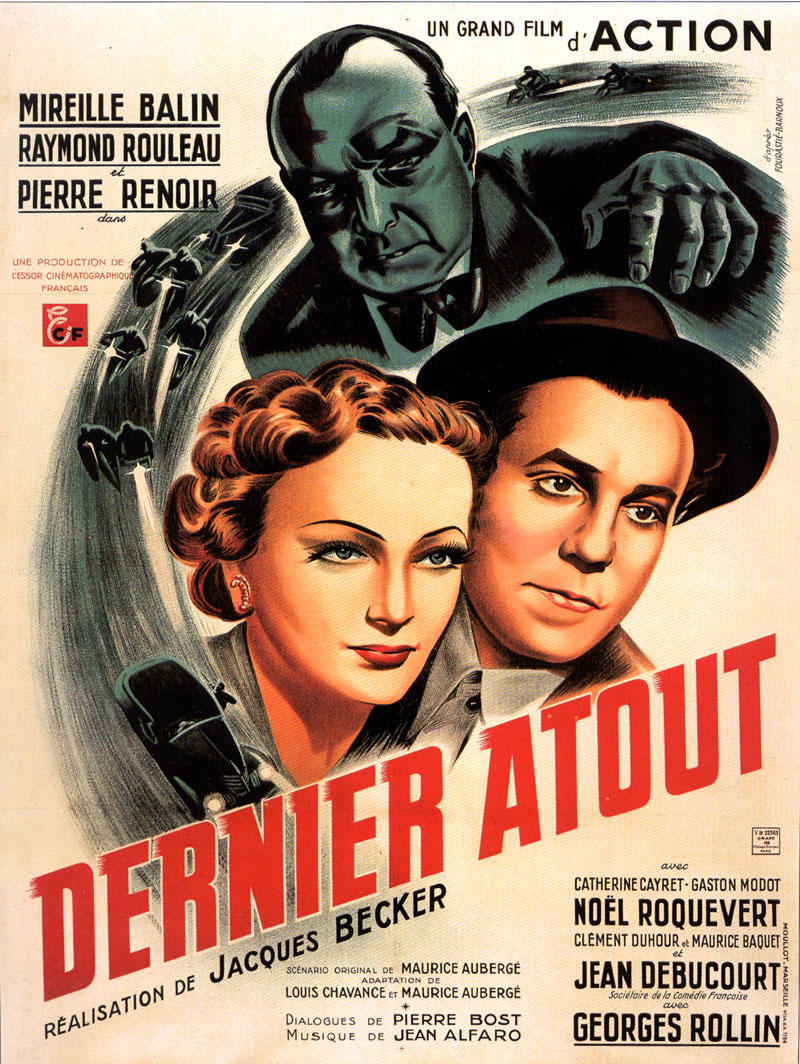
DIPLODOCUS in the
crossword puzzle, sound of steady gunfire, target practice, “à CARICAL capitale
d’un pays imaginaire”, in 1942, the year of a
more famous film, Casablanca (dir.
Michael Curtiz), the title might be translated Last Trump, not target practice, a shooting match.
Godard (Cahiers du Cinéma)
on The Perfect Furlough (dir. Blake
Edwards), “rather reminiscent in its furbelows [sc. falbalas]
of Becker’s in Dernier Atout” (tr. Tom Milne).
The better shot
observes, “spirituel comme une baleine,” very like a
whale. A couple of new arrivals (cp. Les Visiteurs du
Soir, dir. Marcel Carné), “votre appartement est retenu.” The crime is
filmed with the utmost adroitness and later imitated successfully by Bresson (Une Femme douce),
he “repeats the experiment” as it were. Scene, Hotel
Babylonia. “Un
crime de luxe, mon vieux.” Detectives of “la brigade spéciale.” The house dick thinks madame shot monsieur, not so the police, “faut jamais désespérer.”
Public Enemy No.
1, the victim, in the U.S.A., mind you. “Bonjour, policier.”
“Bonjour, belle suspecte,”
her Mickey Finn one ducks and dissembles. The Scarface theme (dir. Howard
Hawks), leading visibly toward Touchez Pas au Grisbi. The influence of Huston’s The Maltese Falcon is perhaps merely coincidental.
A very amusing
pair of policiers,
rather like The Super Cops (dir. Gordon Parks) or Freebie and the Bean
(dir. Richard Rush), “pas ici, parce que
c’est sinistre.”
“Où ça?”
“Où ça? Au ciel!”
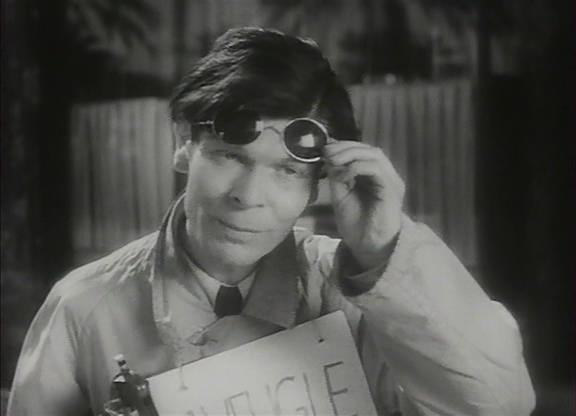
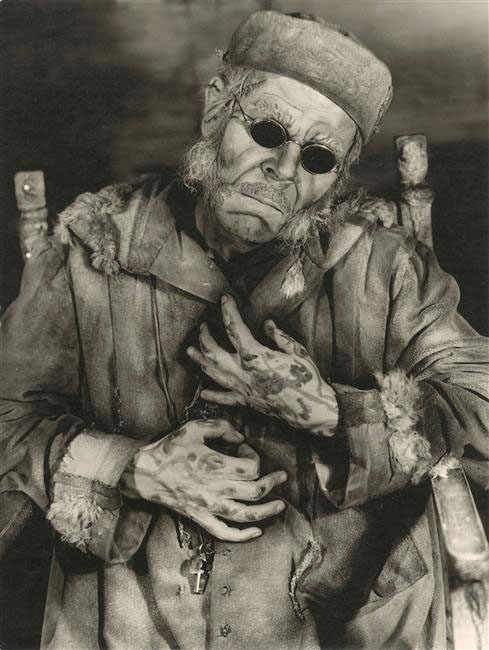
Roger Blin undercover, before Endgame,
“histoire épouvantable!” Truffaut on Bogart, “the man at the microphone: ‘Hello!
Hello! calling all cars...’” the gag is from Hitchcock’s Foreign Correspondent and elsewhere.
Goupi Mains Rouges
The foppish oppidan (he is Goupi Monsieur)
returns in Delannoy’s Maigret et l’affaire Saint-Fiacre, and
this tells of a lady’s murder as well, Goupi Tisane,
all the Goupis have nicknames.
You can tell it
was filmed under the Occupation, but you can’t tell it much.
The title
character’s ruddy mitts...
A fucking riot as
the English say, quietly.
“I went to Paris
once myself, in 1931, during the Colonial Exposition. What a marvel!”
“The Colonial
Exposition?”
“No, no, Paris,
Paris.”
M-G-M released
this as It Happened at the Inn,
subtitled. Bosley Crowther of the New
York Times enjoyed it just before Christmas of 1945, “a truly crackpot
fable.”
In
latter-day Chicago, a “noirish melodrama” (J.R.
Jones, Chicago Reader). Likewise
London, “bracingly mean-spirited” (Time
Out).
And
what is the meaning of this great work, the wisdom of the countryside? Same as Casablanca, “five centimes is a sou,” same as Einstein.
“Sententious”,
said Goupi Crow Bait.
Falbalas
The Paris fashion
designer (Raymond Rouleau) and the textile
manufacturer’s fiancée (Micheline Presle), a furious, brilliant comedy to begin
with.
Les Parisiennes surtout, just
after the Liberation, fresh from various newsreels.
The manufacturer
is one Rousseau. Becker might have Lloyd Bacon’s Footlight Parade in mind, certainly Cagney for the lead (or Fred
Astaire, from William A. Seiter’s Roberta),
yet there is nothing more parisien de Paris,
not even Ernst Lubitsch’s Design for
Living, for example.
The point is a
very rapid style, swift.
The little pony
cart from George Cukor’s The Philadelphia
Story and much else, besides.
What would you
say to some Camembert? “Je m’en fous du
Camembert!” This last from a
jealous model, whose date orders the stuff after she walks out of the
restaurant.
The couturier’s
former mistresses leave original designs in his cabinet, each dated in the war
years and never delivered.
Gabrielle Dorziat is the right-hand woman.
“Today is your
birthday,” says another cast-off.
“What a memory
you have,” he replies. “In five years you’ve forgotten nothing.”
It all takes a
turn, pivots slowly to madness and death.
Becker, dix fois artiste,
has the essential distillate of the theme as the man with designs.
Frills in
English, Paris Frills.
In Time Out Film Guide, “a novelettish tale”.
Antoine et Antoinette
Young married couple,
hard-working, beset by bosses, win the lottery.
It’s run by a
veterans’ organization for face wounds, which is to say they lose face every
day, more or less.
There’s a mixup in a borrowed book, and a dustup with a lecherous
grocer (Antoine is knocked out, his unconscious mind
tells him what he wants to know).
A singular
masterpiece, ten years ahead of the Nouvelle Vague and the New Wave, ten and
twenty more ahead of film technique generally, as sometimes happens.
It reminded
Bosley Crowther of René Clair, but it isn’t René
Clair so he was disappointed (New York
Times). For Aaron Cutler, “the dream called love” (Village Voice). Halliwell agrees with Crowther
exactly.
If it isn’t the
greatest film ever made, it ought to be.
Richard Brody (The New Yorker) has “a clattery plot...
with the blinding heat of erotic passion.” Keith Ullich
(Time Out New York) has “an evocative
line between realism and fantasy.” Film4,
“enjoyable but slight” (echoing Halliwell’s
Film Guide, “a bubbly soufflé”), and “frantic antics”.
Rendez-vous de Juillet
There is a most
careful preparation, handwritten credits shown by hand, and then the sight and
sound of Paris, you are there, pan
right across it, cut to the interior setting at the studio, c’est comme ça, two
shots, a whole film, table set for a semi-formal lunch, daylight in the
translucently-curtained windows, valet putting last-minute touches on the
place-settings, “comme ça c’est parfait.”
Les jeunes gens, in
French to be young is strictly from hunger or else la jeunesse is a trove and the rich are
sent empty away, to cross the river no bridge in view (cf. Altman’s O.C. and Stiggs), what is a diploma from the Institut
des Hautes Etudes Cinématographiques
beside the works of William Asher projected on a beach blanket, anyhow? Pygmies
and rabbit traps at the Musée de l’Homme, acting
school, the little theater...
Dave Kehr (Chicago Reader),
“the emerging existentialist generation.” Time Out, “very thin... rather
uncertain.” Between Capra’s Broadway Bill and his Riding
High that opening scene, Dad prefers French cigarettes (“Ask Dad, he knows”). The audience at the play’s
“not the thing but the effect it produces.” Diabolus in musica, tonic.
An expedition to
the Congo (Time Out says the
“aspiring ethnologist is a fatally humourless and
disagreeable hero,” a fatally humourless and
disagreeable misprision). Film4, “an
interesting portrait of the period.” Hal Erickson (Rovi), “has been credited as the
first postwar European film to accurately depict the Continental ‘youth
culture.’”
And so forth. It
gives Fellini an idea or two, observe our hero at the party, between Pythagoras
and Rouault. Question of The Last Metro,
yet. “Allo!
A l’eau!”
A million
perfectly-rendered observations, the director and cameraman stumbling through
darkness in search of the “auteur dramatique”, for example, because in the last analysis
the subject is film production. “Alors c’était ça?”
Halliwell’s Film Guide, “highly
likeable...”
“C’est formidable!”
Edouard et Caroline
Le jeune artiste et le
monde. Truffaut (Tirez sur le pianiste)
identifies the plain terms in which Becker sets forth his arguments, “pretexts
as slight as a lottery ticket or a dinner jacket...” a particularly intensive
little study of young marrieds at home sets off this
jewel, which might be a Guitry or a Stroheim, practically, or a Preminger (The Moon Is Blue).
A magnificent comedy, entre Denges (Pagnol’s La
Femme du boulanger) et Denezy (Resnais’ L’Année
Dernière à Marienbad). The gradual evocation of a soirée is magnified in
Fellini’s La dolce vita and Tati’s Playtime.
An appointment on
the Rue de Berri.
A.W. of the New York Times found it “much ado about
very little,” to coin a phrase. Halliwell’s
Film Guide, “slight, charming comedy” (citing the Sunday Times on “weighty trivialities” and “a world of
enchantment”).
Casque d’Or
The key to this
otherwise obscure masterpiece is the very obscure casting of Gaston Modot in
the role of an old veteran, for this is the soldier’s death in slow-motion, an
obscure gentleman who kills and dies for a certain someone who here is made to
observe his death.
The mechanism of the screenplay, since we must pay
attention to such amenities, has him simply brave and very heroic and finally
determined in what is, with Becker, a tale of Paris scum, but for the soldier.
Pauline Kael made herself an ass over it in The
New Yorker, missing the point as always, but that is no matter (so did
H.H.T. of the New York Times, but that is neither here nor there).
“But Becker’s best film, the one in which he rises above
his own limitations, is Casque d’Or, which has unfortunately never
been understood in France—a rapid, tragic, powerful film, every instant filled
with strength and intelligence” (Truffaut).
Rue de l’Estrapade
From Passy and a view of the Eiffel Tower to the old strappado “near the Pantheon”,
because her husband is unfaithful, and it will be observed that the 17th-century
staircase is Bossuet (“paroles d’étonnement”), a maid’s room
high up, formerly.
“Only Becker was,
and is, French as France... splendid” (Godard).
A great affinity
for Sacha Guitry, a considerable influence on Bryan Forbes (The L-Shaped Room), Renoir (and
Hollywood) in the background.
The couturier on
the Champs-Élysées is by way of Falbalas,
the structure is very useful and serves for Away
from Her (dir. Sarah Polley) in the fullness of
time.
J.R. Jones (Chicago Reader), “good-hearted
melodrama”.
Hal Erickson (Rovi), “does not quite measure up to its predecessor”.
Halliwell’s Film Guide, “lightly likeable”.
Touchez Pas au Grisbi
“Grisbi” means loot, 96 kilos of gold, stolen at Orly. Max (Jean Gabin) is retiring. The gangsters’ world he
lives in is settled and refined, squares are out, “tu”
says everyone, one goes to bed early. It’s as quiet as the office of Spade
& Archer at the beginning of The Maltese Falcon.
His partner and
old pal Riton (René Dary)
loses his head over a dame (Jeanne Moreau), she tells Angelo (Lino Ventura) about the gold, and very quickly there’s a
war.
Mike Hodges did
the best analysis, in Get Carter, whose subject is the European War
1939-45, with particular reference to the Normandy invasion. Touchez Pas au Grisbi
is about the fall of France and the Liberation. Someone else wanted the loot,
there was a terrible cost, the cops got it after all.
Riton is kidnapped. Max recollects their friendship. A
woman telephones, out of the blue, he goes and sees her... Becker invents a
variation of Mary Astor and Humphrey Bogart (the “fireplace poker” scene),
emphasizing the beauty of it. Afterward, Max resolves to rescue Riton. The other major influence is The Big Sleep.
Never has a
director been more conscious of his soundtrack. Every sound, footsteps, cars,
cloth, dishes, everything, is precisely recorded at the correct tone, as a
point of artistry but also to counteract the allegory (“on the banks of the
Nile”).
The new English
translation calls machine guns “rods,” gives “don’t sweat it” for “n’insiste,” and has Riton
say “Take your own bed. I can crash here.”
Becker’s
showgirls include la petite Moreau, avant
tout. His gangsters spring from lethargy into furious action. His opening
pan under the credits moves along the rooftops of Paris and finally settles on
the Moulin Rouge (between Graff and Cyrano), to piano notes and string chords
like Home Town Story. Denise Clair is a remarkable likeness of Thelma
Ritter as Madame Bouche.
The
mysteriousness of signs in Paris streets, Club Mystific
(where the girls dance), Hotel Moderna (where Riton lives). “Sacré Max,” a
tough calls him, after the shootout.
Ali-baba
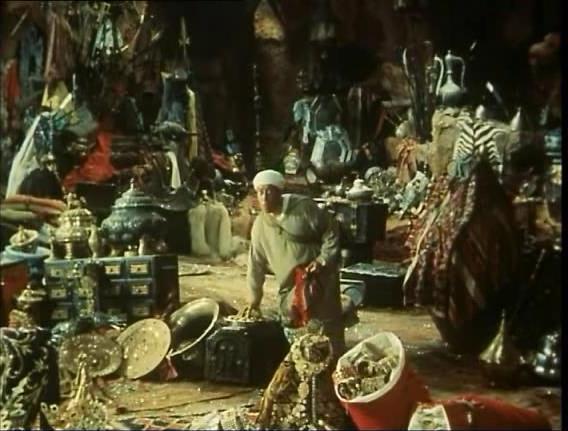
“Comédie-farce en Eastmancolor”.
A night in A Thousand Nights and a Night.
On a commission
from his master, he buys a girl in the bazaar, not so fat as expressly wished,
but fair and more fetching a dancer than his master’s jades. The girl is
alarmed at patronly advances, Ali-baba
allays them with a sleeping potion, how to amuse the girl? With a birdseller’s parrot she admired on the way, too steep then
at fifteen piasters...
Off he goes on
his skittering ass to buy the beast in a real Araby.
The caravan is
attacked, Misraki evokes Rimsky-Korsakov, Ali-baba
hides in one of the camel baskets and so is carried off with the rest of the
plunder.
“Sésame, ouvre-toi!”
The genius of the
ages, and the comedy as well (when Ali-baba says,
“open, sesame!”, the parrot’s cage door opens, then
the treasure cavern).
For the role, Fernandel with his striking resemblance to Formby and
Camus.
Delacroix and Ingres,
which of course brings us to Robbe-Grillet’s Arabian nights.
Ali-baba, trés riche, buys
the girl. The master-that-was horns in.
The forty
thieves.
Arab manuscript
painters figure throughout and notably in the sumptuous interior of Ali-baba’s newly-bought home.
“Pas mal, hein?”
The girl’s father
puts her on the market again. “C’est encore moi!”
The wedding
guests are “peut-être nombreux,”
they fight each other to the death.
“La vie est douce,
hein?”
“30 scènes de ce film
sont éditées en relief et en couleurs par les Stéréofilms
Bruguière”.
Les Aventures d’Arsène Lupin
When Franju made Nuits
rouges fifteen years later chez
Feuillade, his technique reached
the same conclusions as
Becker here on his
gentleman thief, “une
célèbre personnalité parisienne.”
“Mille regrets,
Monsieur le Président, mais votre Michel Ange est faux!”
The manicurist,
her bountiful father.
The German
baroness.
The style is, as
Truffaut would say, “images d’Épinal”.
The gypsy-genius
and the gadjo-gadget,
Andersen’s nightingale.
“Un nouveau fléau,”
Le Petit Journal announces,
“LA LUPINITE”.
A new plague, lupinitis.
And that is how
the title character came to be kidnapped into the Deutsches Reich by the Kaiser.
A supreme work of
genius, sans doute,
sans doute,
with very grand reference to Renoir (La
Grande illusion).
Reden an die
deutsche Nation, in her castle
boudoir the baroness is reading, the Addresses
of Fichte.
Bobby, the
Kaiser’s black panther, adds a note of Franju surrealism, perhaps.
A work, Lupin explains, of artistic and poetic imagination.
“Donnerwetter,”
exclaims the Kaiser. “Désolé Majesté... mais vos statistiques sont
fausses!”
Die Baronin ist ein
Scharfschütze...
Maxim’s, “Au cours
de la Saison”, at midnight...
the maharajah.
Truffaut the
critic contrived to be bored. “Just compare a photograph of Becker seated at
the wheel of his Mercedes with the opening shot of The Adventures of Arsène Lupin
and you will see that Robert Lamoureux was his
spitting image,” Godard says.
Les Amants de Montparnasse
(Montparnasse 19)
The Academy is a
rich mistress, exhibiting her nude in a gallery window brings the police and no
takers, the American system of distribution is
rejected outright.
A shrewd dealer
waits for the right moment, watches the artist die and rushes to buy his
pictures from the widow.
Godard’s
remarkable note (Cahiers du Cinéma 83) is cited by Truffaut.
Russell is in
accord with that formulation, he reverses the breaking of the gallery
window for Savage Messiah, cp. The
Doctor’s Dilemma (dir. Anthony Asquith).
“Hier... en 1919,” Modigliani.
“These things are
not explained,” Bosley Crowther (New York Times) complained, practically
quoting the screenplay.
Le Trou
Madame Gaspard’s shotgun comes from Seiter’s Sons of the Desert, that is the basis of the lark.
M. Gaspard loves her teenage sister, cause of the row. The
girl is a bit of a coquette.
In prison, he
falls in with a laborious escape attempt well-described by reviewers. Madame
drops the charges, the girl is in England, escape is hours away.
So much attention
has been paid to the superfices of the Rififi action, the point has been
overlooked.
“A superb film,
superbly conceived, written, directed, edited, and mixed” (Truffaut).